

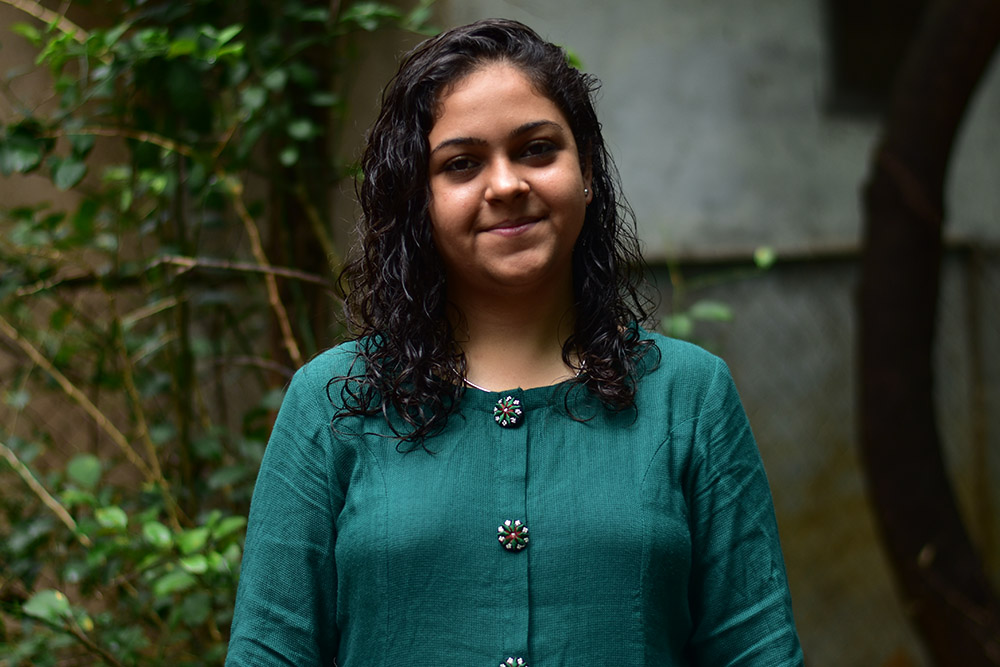
When Ankita Nagpal boarded a flight from India to the United States two years ago, she brought with her a passion for writing and a sense that she needed time and community to grow into the writer she hoped to become. She had never been to the United States.
She had never visited Stony Brook University, yet she had decided Stony Brook was the place where she would commit to the work of writing and grow as a writer.
Nagpal is now a third-year student in Stony Brook University’s MFA in Creative Writing and Literature program. She lives in Brooklyn with her husband and spends much of her week on the university’s Southampton and Manhattan campuses for her classes in creative writing, and the Stony Brook campus for her assignments as a teaching assistant for the BFA program. She does not own a car and relies on trains and buses, but sees the commute as part of the experience and happily accepts it as a necessary means to the education she came here to pursue.
“I get to read and rest and sleep,” she said. “The trip is long, but it gives me time to think. I want to get the best education that I can, so I do not let distance deter me. If there is a class that I want to take, if there is a professor that I want to spend time with and learn from, I will travel six hours a day.”
Nagpal was born in a small village in India and completed an undergraduate degree in telecommunications engineering at the University of Mumbai. Writing had always been present in her life, but the idea of pursuing it felt unreachable due to the expectations surrounding her.
“There is this pressure to pursue a practical career,” she said. “You choose a STEM field because it pays the bills. That is one of the reasons that I went to school for engineering.”
After graduating, she spent six years moving through different fields. She worked as a content curator with TEDxGateway, helping speakers craft talks and learn how to carry themselves on stage. She shifted into Java development at the Bombay Stock Exchange, writing trading algorithms for private clients. She completed a diploma in astronomy and astrophysics. Later she worked in content marketing, eventually leading a team.
During those years she gained professional experience and a clearer understanding of what she was missing. “I listened to myself,” she said. “I thought, okay, it has to be writing.”
She began preparing applications for creative writing programs in the United States, the United Kingdom and Canada. She read the work of faculty members from thousands of miles away and tried to determine which voices aligned best with her own. The longer programs in the United States appealed to her. “I needed more time to bloom in my chosen field,” she said, and appreciated the length and substance of the two-and-a-half-year Stony Brook MFA curriculum.
While she received several program acceptances, in order to make a final decision, she made spreadsheets, reached out to faculty members and talked with her then boyfriend (now husband) in Boston about cost of living and whether she could manage without a car. The process led her to narrow her options to Boston and New York.
A conversation with former MFA Program Director Molly Gaudry, who was leading the program at the time, became a pivot point. “She was one of the few who was being honest with me,” Nagpal said. “She said this is a program for people who are serious about writing. It is not for you if you want to come here and party and have fun. You have to care about your work.”
This program has given me space to grow into the person that I had hoped to be.
That honesty mattered, as did the program’s structure. Stony Brook’s MFA is multidisciplinary and allows students to take classes across fiction, nonfiction and poetry. “The program’s ideology is that each genre informs the other,” she said. “Something that I learned in poetry would change how I write fiction. That kind of flexibility and generosity made me choose Stony Brook.”
She credits several of the faculty who have shaped her writing, including Amy Hempel, Susan Scarf Merrell, Molly Gaudry, Karen Bender and Julie Sheehan. She described discovering their work while still in India and feeling a connection across distance. She also noted the impact of Robert Lopez, whose classes in Manhattan often become social gathering opportunities for students who stay after class to talk about writing or meet for dinner or drinks nearby.
While creative writing programs can often carry reputations for competitiveness, Nagpal said that her experience at Stony Brook has been the opposite.
“I’ve often heard that in some programs peers will give unhelpful feedback, or misinform each other,” she said. “That is not something that I have ever seen happen here. There is so much community, and groundedness.”
Her cohort is spread across workshops, literature courses and required practicums. Students cross paths in Southampton, Manhattan and Stony Brook. They attend Writers Speak events and meet peers from the film and television program.
“One of my classmates officiated my wedding,” she said. “Everyone is very thoughtful and kind. It sounds unreal, but I think this is one of the few programs that has such a supportive environment.”
Nagpal entered the MFA as someone without formal academic training in writing. She said the program reshaped nearly every part of her process. She now thinks more about character development, structure, rhythm and how each sentence carries meaning.
“I went from being a genre writer to a literary writer, focusing more on characters and on plot,” she said. “My sentences are more rhythmic. I am drawn to experimental, surrealist writing and the program is pulling me back to poetry. That would not have happened in a single-track MFA.”
Her growth has also been influenced by her work as a communications assistant at Stony Brook’s AI Innovation Institute. She interviews researchers across disciplines, attends events and hears how scientific ideas take shape. She is also taking a class in translation studies at Stony Brook. That course, she said, expanded her understanding of how language, culture and history shape one another.
“The world opens up,” she said. “I am able to see how the constraints of cultures have shaped language across time, and space, and how foreign languages can make a society whole.”
Nagpal recently finished the first draft of her novel, which draws from family history and blends fiction, memoir and prose poetry. She describes it as a multigenerational, magical story set in India, concerning faith, feminism, occult, the body and the tension between what is good and what is right.
“It is the story of a woman who marries into a patriarchal household,” she said. “When you are physically powerless, societally oppressed, how do you keep your place in this world? There is mental, emotional, and physical scaffolding, and a radical way forward.” She hopes that readers will find an emphasis on empathy and kindness throughout her work.
With graduation approaching, Nagpal describes her time at Stony Brook as demanding but transformative.
“So much of my writing has changed,” she said. “This program has given me space to grow into the person that I had hoped to be.”
Read more such stories at the SBU News website.