

Stony Brook, NY, 26th March, 2026 — How challenging could it be for AI to rewrite The Great Gatsby without the letter ‘e’ and in a way that doesn’t dampen the essence of Fitzgerald’s tragic masterpiece?
For Steven Skiena, distinguished professor of computer science at Stony Brook University, this question doesn’t just present an interesting writing challenge but addresses a far bigger concern: how can LLMs effectively translate nuance, voice, and style when presented with very strong language constraints?

In a paper presented at the IJCNLP-AACL conference, Skiena and his students trained a language model to write an e-less version of The Great Gatsby using AI. “The letter ‘e’ makes up roughly 12 percent of ordinary English text,” Skiena said, “and the text we produced serves as a testament of the malleability of the English language.”
Here’s a passage from Gatsby: Without the E:
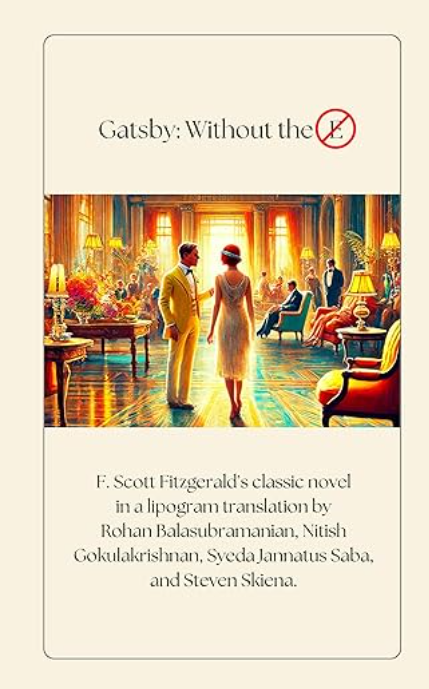
This habit has brought to light a lot of curious minds, which I also had to put up with as a victim, not to say that I wasn’t a boor in my own right. Abnormal minds quickly pick up on this trait and cling to it in normal individuals. It was in this way that, during my school days, I got unjustifiably caught up in politics, as I had a knack for picking up wild, unknown man’s sorrowful thoughts, most of which had nothing to do with politics. My confidant was usually a plagiarist, with obvious omissions. Holding on to your opinions is an act of faith. I’m still afraid I might miss out on a thing or two, if it wasn’t for my dad, who was a bit of a snob in his own way. And I, in turn, am just as snobby as him.
For Skiena, the project began not with Gatsby, but with disappointment.
“When I first heard about this novel called Gadsby, I thought this was an incredibly cool stunt,” he said in an interview. Gadsby, a 1939 novel by Ernest Vincent Wright, is famous for being the first novel written entirely without the letter ‘e’. “I went out of my way to get a copy. And it was horrible.” What fascinated him was not simply that someone had managed the stunt, but whether it was possible to do it well.
Skiena and his students framed the task as a kind of translation — not from English to French or Hindi, but from ordinary English into a constrained version of itself. The challenge was to create a successful translation that can swap words and restructure sentences, but should preserve meaning, readability, and flow. That is what makes the project more than a gimmick. It becomes a stress test for language models, asking them to obey a severe rule without collapsing into nonsense.
The team began with simple baselines, and they failed in predictable ways. One method simply deleted every ‘e’ from the text. Another tried to replace words with e-less synonyms. Both followed the rule, but the results were awkward, broken, or barely readable. More advanced systems did better. The researchers tested several models, including GPT-4o, T5, Llama2, and Llama3, and continued to add a series of refinements: training on paraphrased texts, generating multiple translated versions and then choosing the strongest one, and refining the text to ensure clarity.

The best performer was Llama3. Across all test cases, it produced the most readable and grammatically sound e-less text while staying closest in meaning to Fitzgerald’s original. All of the final systems that made the cut obeyed the no ‘e’ rule completely, but Llama3 came closest to making the result feel like real prose. The cruder methods, by contrast, introduced far more grammatical mistakes and malformed words.
Skiena is quick to say that, for him, the most important metric is not a score in a table.
“There’s writing for computer scientists. We like to score things to know how well we’re doing. But on this particular task, the real issue is, can people read this and understand it even though there are no ‘e’s?"

That is where the project becomes genuinely inspiring. “We expected the text to fall apart once we removed something as common as the letter ‘e’. But it didn’t,” said Syeda Jannatus Saba, a CS Ph.D. student at Stony Brook University. "It still held together in ways we didn’t expect. That tension between a strict constraint and meaningful language is what made the project exciting for us. It stopped feeling like a playful idea and started becoming a way to see how far we can push language while still keeping meaning, structure, and style intact.”
This led the team to a second question: how heavy a set of constraints can English survive before meaning really begins to fall apart? So they pushed beyond the letter ‘e,’ generating versions of the text that excluded other letters, and even combinations of letters. Their results showed that English holds up surprisingly well under weaker restrictions. Eliminating any of the 16 least frequent letters — up to ‘u,’ which accounts for about 3.6 percent of ordinary text — caused minimal loss of meaning. Beyond that point, however, the decline was steep. Stronger constraints began to interfere with the story Fitzgerald wanted to tell, and as the alphabet disappeared, the text naturally collapsed into gibberish.
The paper is honest about AI’s limitations. No one, the authors note, is likely to prefer the lipogram over Fitzgerald’s original except as a curiosity. The system still struggles to maintain coherence and consistency across the larger text. But curiosity, in this case, is part of the point. The project has created a playful but revealing space to think about constrained writing.
“Translation is a classical problem in natural language processing. Getting the nuances right, ensuring grammatical correctness and readability, and maintaining semantic similarity to the original is not easy. But AI models are getting better.”