


Stony Brook, NY, April 2, 2025 — When sociologist Manisha Desai talks about artificial intelligence, she doesn’t start with algorithms. She starts with power.
“Technologies reproduce the inequalities of the society in which they’re created,” she said in an interview. For Desai, Executive Director of Stony Brook’s Center for Changing Systems of Power and Empowerment Trust Endowed Professor of Global Citizenship, AI is simply the newest arena where old hierarchies — gendered, racial, colonial, and economic — are being rewritten into code.
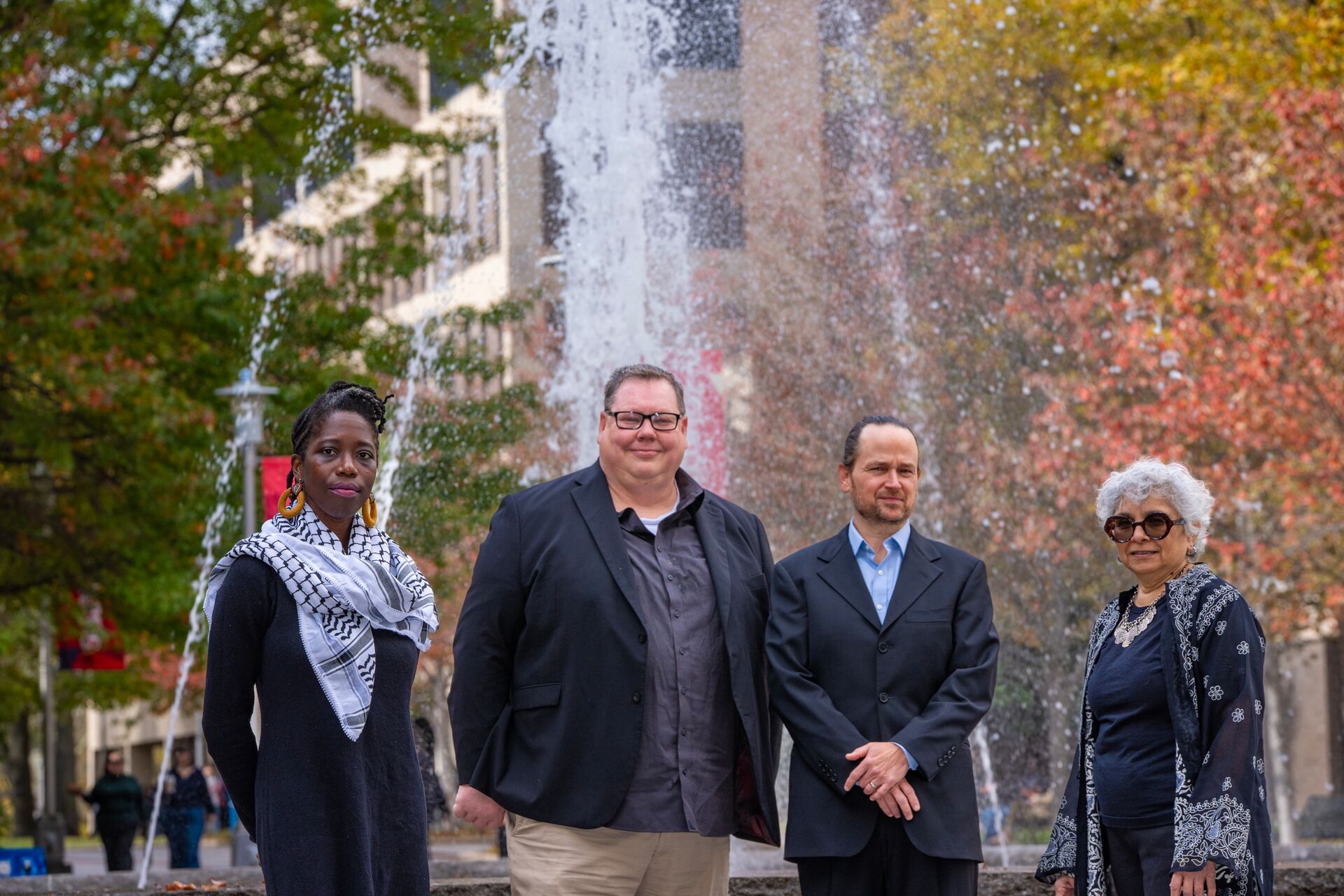
This long-standing critical lens is at the heart of a funded project on the practice of democracy and academic freedom, which Desai is partnering alongside Michael Rubenstein (professor, the Humanities Institute, College of Arts and Sciences), Abena Asare (associate professor, Africana Studies, CAS), and Robert Chase (associate professor, Department of History, CAS). The funding supports research on historical and cultural sources of contemporary developments, through a multi-year project at Stony Brook, beginning with a symposium.
Desai’s work sits at the intersection of gender, globalization, feminism, climate justice, and human rights. She’s a senior research associate of the United Nations Research Institute for Social Development (UNRISD), and a member of the Global Network for Research and Action for a New Eco-Social Contract. Across these roles, she keeps returning to one question: who benefits from change, and who pays the price?
With AI, Desai sees two layers of concern.
On one hand, there’s the familiar story of inequality and control. The internet once arrived wrapped in promises of democratizing knowledge and connection. In practice, Desai notes, it has enabled intensifying corporate control, mass surveillance, and the commercialization of private data. AI, concentrated in the hands of a few large corporations, risks deepening these patterns.
On the other hand, one must consider the ecological cost of AI’s infrastructure, especially for communities on the front lines of climate change. Desai points out that data centers are often constructed in marginalized areas, consuming vast amounts of water and electricity while worsening pollution. Even proposals for “community-owned” data centers don’t resolve the primary issue.
“No amount of green energy is going to make up for the energy needs of AI,” Desai said.
She emphasizes that her position isn’t anti-technology for its own sake. “It’s not about being a Luddite. But it's important to understand the ramifications and ask whether this or any other model of AI can ever be a source of social justice.”
The project will bring these questions home to Stony Brook. Rather than focusing only on AI and the future of learning, as many initiatives do, Desai and her collaborators will focus on how AI practices shape the practice of democracy and academic freedom at institutions.
They plan on convening scholars from around the world on three intertwined arenas:
- Classrooms: How is AI being used in teaching and learning? Does it expand students' capabilities or narrow their learning experiences and their ability to think critically? Desai wants to focus on students’ academic freedom as much as faculty rights.
- Research: What happens when AI tools summarize literature, generate drafts, or even suggest “promising” topics? How do we protect the integrity of research when the systems that propose projects may also shape what gets funded and published?
- Governance: Universities are increasingly turning to algorithms to guide decisions and make policies — from enrollment to performance metrics. Desai’s team will ask what that means for democratic life on campus.
The first year of the project will be a planning year, involving inviting speakers, designing workshops, and building space for faculty, staff, and students to think together. The project will also support hands-on workshops on AI in classrooms, administration, and scholarship.
“As a public university, our job has to be more critical than simply accepting AI because it’s there and becoming ubiquitous,” Desai said. “We don’t have to go with the flow.”
Despite her focus on AI, Desai’s core research question has stayed remarkably consistent across her nearly 40-year career. She studies how marginalized people, especially women, enact social transformation. Her earlier work examined social movements in Gujarat, India, contesting large-scale “development” projects under the Modi regime, asking: who gets displaced, who gets heard, and what alternatives do grassroots groups imagine?
More recently, her attention has turned to climate justice. She is part of an international project on eco-social contracts with UNRISD. Their work argues that traditional “social contract” thinking, centered on the relationship between a state and its citizens, is both limited and incomplete. Without ecology, she says, there can be no sustainable justice.
Desai is also working on another project with women farmers in India who have developed a model of climate-resilient agriculture. Rather than going in with survey teams, Desai worked with Swayam Shikshan Prayog, an NGO, to train the women farmers to be co-researchers.
“Research can’t be extractive,” she said. “If I take people’s stories and turn them into publications, what do they get receive?”
The women farmers interviewed one another — more than 2000 participants in total — and the findings are now being written up for both scholarly and community use, including a forthcoming article in Current Sociology. Desai is also co-authoring a piece on feminist futures for AI for the International Feminist Journal of Politics, exploring the role of refusal, resistance, and transformation based on feminist values of care and eco-social justice.
Desai’s climate work is not limited to the Global South. Her ongoing project with collaborators Kathleen Fallon (professor, Department of Sociology, CAS), Linda O'Keeffe (professor and chair of the Department of Art, CAS), and Chris Sellers (professor, Department of History, CAS), is in partnership with Erase Racism and the Long Island Progressive Coalition. The seed grant — Climate Justice through Community and Arts-Based Research: Building Collaborative Solutions for Marginalized Communities on Long Island — has allowed the team to focus on climate justice on Long Island.
One part of the study looks at the experiences of Indigenous communities, including Shinnecock and Setauket groups, whose relationships with land and water have been constrained by pollution, development, and restricted access. Another works with high-school students who have gone through leadership programs, and who identified environmental inequalities in their neighborhoods. Like less green space, higher summer temperatures, and more exposure to polluted air and water.
This research will also include sound workshops, led by professor Linda O’Keefe of the Department of Art, inviting participants to “listen” to their environments — traffic noise, birds, sirens, waves — and ask what those soundscapes reveal about climate and justice.
They’re also building digital story maps to layer histories of redlining, health disparities, and environmental hazards and show the cumulative impacts of racial and economic inequality over time. Those maps, Desai emphasizes, are not just for academic audiences. They’re tools communities can draw on in organizing and advocacy.
She is also part of the Steering Committee of Stony Brook’s new Department of Technology, AI, and Society, where she advocates for pairing technical training with critical reflection. There is, she acknowledges, a certain optimism baked into her work. “Movements always have a vision of working for social justice,” she said, “even if they don’t always win.”
At the end of the day, Desai returns to a simple question, one she hopes this project, and the broader campus, will continue to ask. “Is AI going to promote a just and sustainable society for all, or only for the privileged few?”