

Stony Brook alum and Senior Director of Programs at the National Academy of Engineering, Guru Madhavan shares insights from his latest book and discusses accountability, civic coordination, and learning in the age of AI.
Stony Brook, NY, Oct 30, 2026 - In the spring of 1863, at the height of the American Civil War, President Abraham Lincoln signed a congressional charter, establishing the National Academy of Sciences (NAS). The nation was undergoing drastic technological changes, and ironclad warships were rapidly replacing wooden naval fleets. One of the charter’s very first assignments was to help the Navy navigate through severe technical challenges in marine environments. When scientists discovered the cause — that it was saltwater deteriorating the iron hulls — their perspective on technological advancement changed. New technologies create problems that existing frameworks cannot anticipate, and solving these challenges requires stripping the problem down to its atomic mechanics and facing the unknown. This is what Dr. Guru Madhavan calls “intellectual fearlessness.”
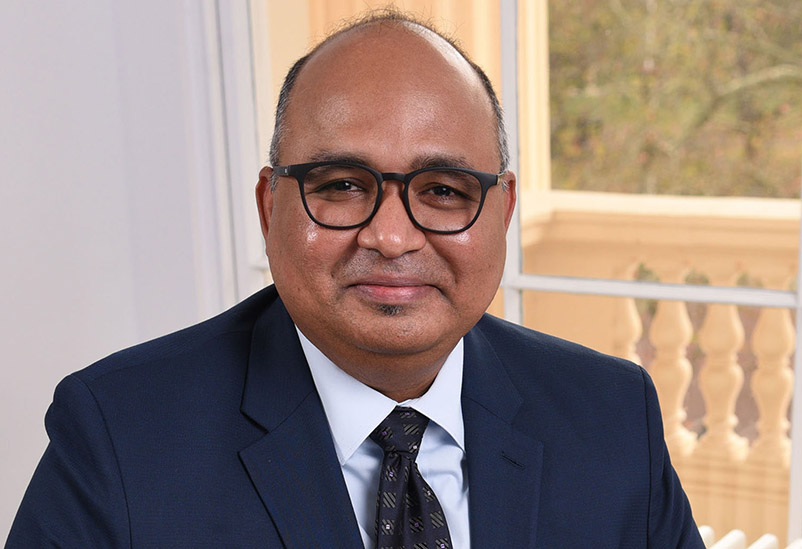
“People like me come and go, technologies come and go, but that intellectual fearlessness guided our founding and guides us still,” says Madhavan, Norman R. Augustine Senior Scholar and Senior Director of Programs at the National Academy of Engineering (NAE) and a proud Stony Brook University alum. Sitting down with the Stony Brook AI Innovation Institute, Madhavan shares his views on our current societal shift into artificial intelligence (AI), not through the popular lens of hype, but through the experiences of a weathered engineer. For Madhavan, a systems scholar whose career spans engineering design, public health, technical advising, civic responsibility, and foundational texts like Applied Minds and Wicked Problems, AI is far more than an instantaneous answer generator. It is a new, invisible layer of civic infrastructure. And like the iron warships of 1863, its rapid deployment is changing how technology, people, and processes interact and serve (or not serve) society.
AI as a “Wicked Problem”
At NAE, Madhavan leads a multi-stakeholder initiative to advance understanding of complex technical and social systems and to identify unifiable approaches to manage them better. “I'm interested in large engineering systems with large consequences, even small engineering systems with extra-large consequences. Think of aviation, power grids, health infrastructure, digital commerce — they all operate through a large network of invisible coordination, standards, and maintenance regimes often put together by people of diverse backgrounds.”
When engineers talk about AI, the conversation often digresses into a quantifiable feature race: hallucination rates, benchmark scores, or the raw compute packed into server farms. But Madhavan insists that viewing AI merely as a product overlooks its systemic reality.
“AI functions less as a single technology, or even a singular technology, but as a whole new layer of infrastructure,” Madhavan observes. “It changes how information flows, it changes how decisions are made, it changes how organizations coordinate.”
AI’s disruption, then, is not merely technical, but cultural. Framing AI around NAE’s programmatic priorities centered on engineering competence, capability, and character, Madhavan points out that AI is altering the relationship between human judgment and automation. “Think about it,” he says, “artificial intelligence is fundamentally reshaping our expectations about what knowledge means, what expertise means, and what imagination means.”
He contrasts the immediacy of modern answer engines with the slow process of human learning. “I studied Taylor series approximation as a student, but I struggled to understand it. I don’t think I was even good at it, but I enjoyed doing it. It wasn’t until 15–20 years later, in a work setting of an entirely different context and consequence, that the stuff that I learned way back in school started to make deep sense.”
That kind of long horizon of illumination that abruptly pops up is quite different and profound. “Does that late realization count as intelligence, actual or artificial, versus the barrage of instantaneous answers you have in front of you?” Madhavan asks. “I don't think we have the language to talk about this yet.”
Navigating this uncharted territory requires dealing with what’s called "wicked problems" — engineering challenges where the boundaries of a problem are blurred, entry and exit points are obscured, and standard brute-force integration does not apply. Instead of attempting to force complex societal systems into rigid technical boxes, Madhavan notes, engineers must learn to engage with systems on their own terms and values.
Learning Systems Over Machines
Madhavan’s daily work involves analyzing and articulating the seemingly unremarkable, deeply vexing elements of engineering. Instead of considering how intelligent a model is, he has been thinking about how AI can be responsibly governed, and how it has been affecting the systems both surrounding and supporting it.
In his latest book, The Blue Box: Ed Link and the Birth of Modern Aviation, a spin-off of Wicked Problems, he brings up a story from 1929, when Ed Link, a high school dropout working out of his father’s piano factory in upstate New York, built a rudimentary wooden cockpit mounted on organ bellows. It became the world's first practical flight trainer.
Before Link’s invention, aviators were learning to fly by trial and error. Link’s device offered a safe environment to practice spatial orientation and cultivate instrument-based judgment on the ground. During World War II, his "Blue Box" trained hundreds of thousands of Allied Pilots, establishing the modern concept of simulation as preparation. “Engineering progress often comes from improvements in learning systems, rather than the machines themselves,” Madhavan emphasizes.
“So far, we’ve been using AI without fully understanding how it works, or fully realizing its power and consequences, which means there are many knowns and far more unknowns around AI,” Madhavan says. “Using the tool for many complex problems has given us absurdly high levels of confidence that we can do X, Y, and Z, without even training for it.”
The Link Trainer did not remove pilots from the cockpit. It improved the pilot's ability to interpret instruments and manage uncertainty. AI-based training systems, if designed carefully, could play a similar role in enhancing contextual reasoning, using pattern recognition to sharpen human judgment in high-stakes environments like medical diagnostics, logistics, and scientific discovery.
The Engineering of Civic Stewardship
As AI models are deployed at unprecedented scale, the risks shift from individual software bugs to systemic fragility. Concentrating power in opaque systems while eroding long-standing institutional safeguards creates a dangerous gap between technical capability and societal trust.
For Madhavan, addressing these risks is a foundational engineering responsibility. “What most engineers declare as ‘not their problem,’ that’s my problem,” Madhavan says. “The engineering mind is such that even having accelerated the world, we thought of including speed limits. Both are the responsibility of engineers, to get us to a point safely and reliably.”
This obligation demands a re-examination of the traditional engineering mindset. While that mindset built the modern world, complex systems now require engineers to view their work as an act of civic coordination. Reliability, interpretability, and alignment with human institutions are the “speed bumps” that keep high-speed technological advancements from veering off course and harming ourselves and others.
Continuing the Conversation
The sheer speed of AI development can make meaningful reflection a luxury. Yet, as history reveals — from Civil War ironclads to flight simulators — technologies must always be anchored by the institutions, cultures, and deliberate training practices.
Madhavan says, “This is precisely where hubs like Stony Brook University’s AI Innovation Institute come into the picture.” Free from the commercial pressures of chip design or data center optimization, universities have a choice to bridge technical disciplines, social sciences, and ethics.
As we step into this next technological era, the AI Innovation Institute invites researchers, students, academics, and industry leaders to join this ongoing dialogue. How do we design learning systems that elevate human judgment? What speed bumps must we build to protect civic trust? The conversation is open, and shaping the future of unifiable systems will need all of us at the table.