

Forty undergraduate students from Farmingdale State College and Suffolk County Community College shared their work from Stony Brook AI Innovation Institute’s 6-week REU program in AI Innovation & Diffusion.
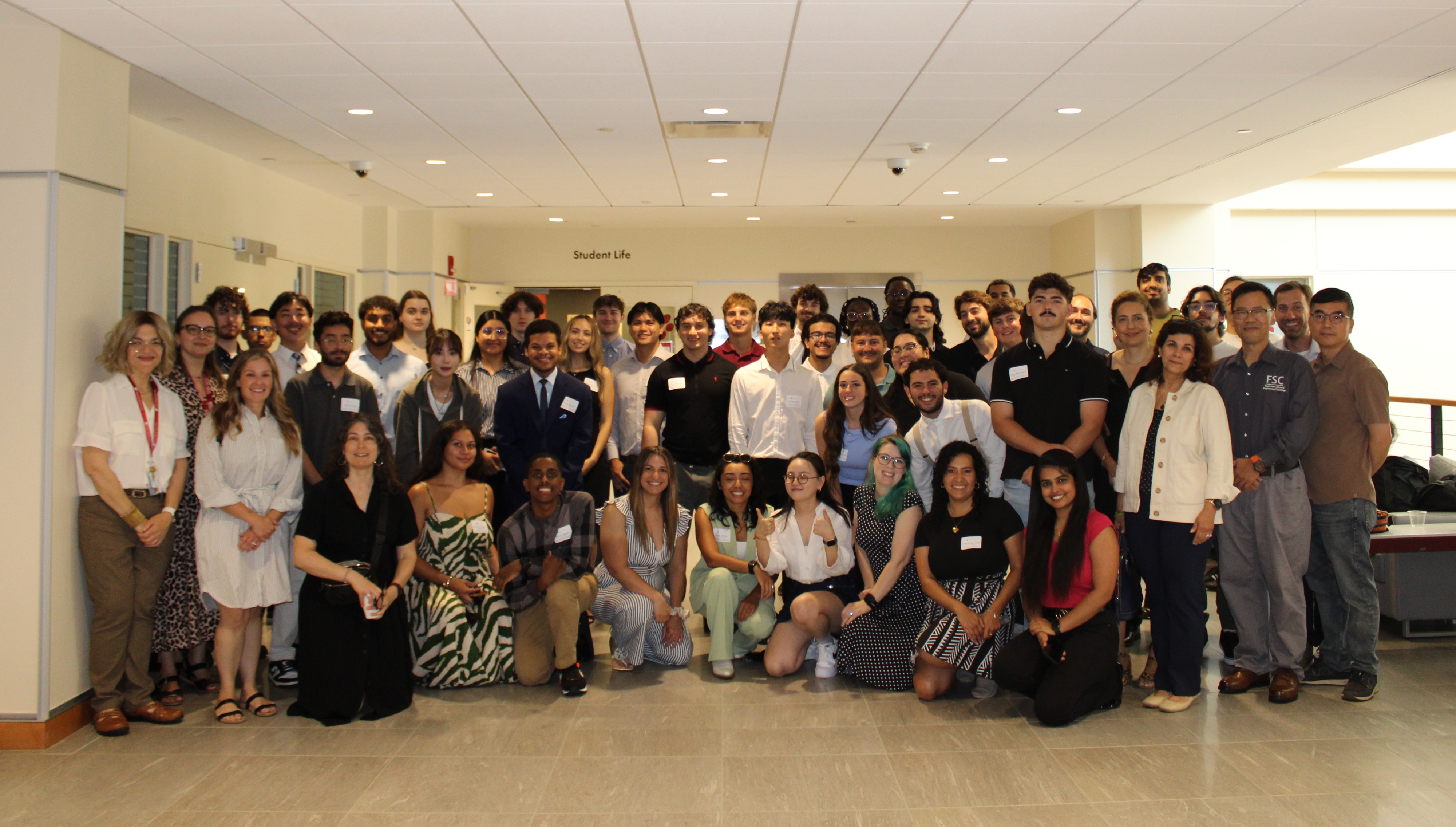
Stony Brook, NY, Aug 14, 2026 - On the morning of 31st July, students across Stony Brook’s summer programs convened at the university’s Union Ballroom. Over a hundred posters lined the space, spanning research across STEM, Medicine, and Humanities. Provost and Executive Vice President Carl W. Lejuez welcomed the participants with opening remarks.
"Undergraduate research is an incredible chance to learn by doing. In the classroom, you learn how to look at your field through the eyes of the people who came before you. What questions did they ask, what answers did they uncover, how did they expand the boundaries of human knowledge and understanding? And that’s so important because that’s also where you learn to see the gaps, to ask your own questions, to use your experiences and curiosity to find out where we go from here," he said. "And undergraduate research is how you can begin to answer those questions for yourself. It’s where you become an active participant in building knowledge. It’s where you get to help us look at and understand the world and its cultures in new ways."
Twenty of the research posters highlighted the research of undergraduate students from AI Innovation Institute’s AI Innovation & Diffusion Research Experience for Undergraduates (REU) program. The six-week paid program, launched in partnership with Farmingdale State College and Suffolk County Community College, recruited twenty students from each partner institution to carry out direct, hands-on research in artificial intelligence.
From June 22 through July 31, these students joined active research groups to work alongside thirteen mentors in seven research laboratories across Stony Brook. The professors, postdoctoral associates, and graduate students hailed from interdisciplinary backgrounds — Computer Science, Computational Applied Mathematics, Biomedical Information Technology, Chemical Engineering, Cognitive Sciences, and Library Studies.
While the forty students arrived from Computer Science, Civil and Mechanical Engineering, Business Management, Applied Mathematics, Applied Economics and Accounting, Electrical Engineering, Nursing and Health Sciences, Chemistry, Paralegal Studies, Psychology, and Architecture. Through REU, they were able to conduct intensive research, attend mentor-led daily labs, and participate in seminars organized by the AI Innovation Institute and taught by faculty from all three partner institutions.
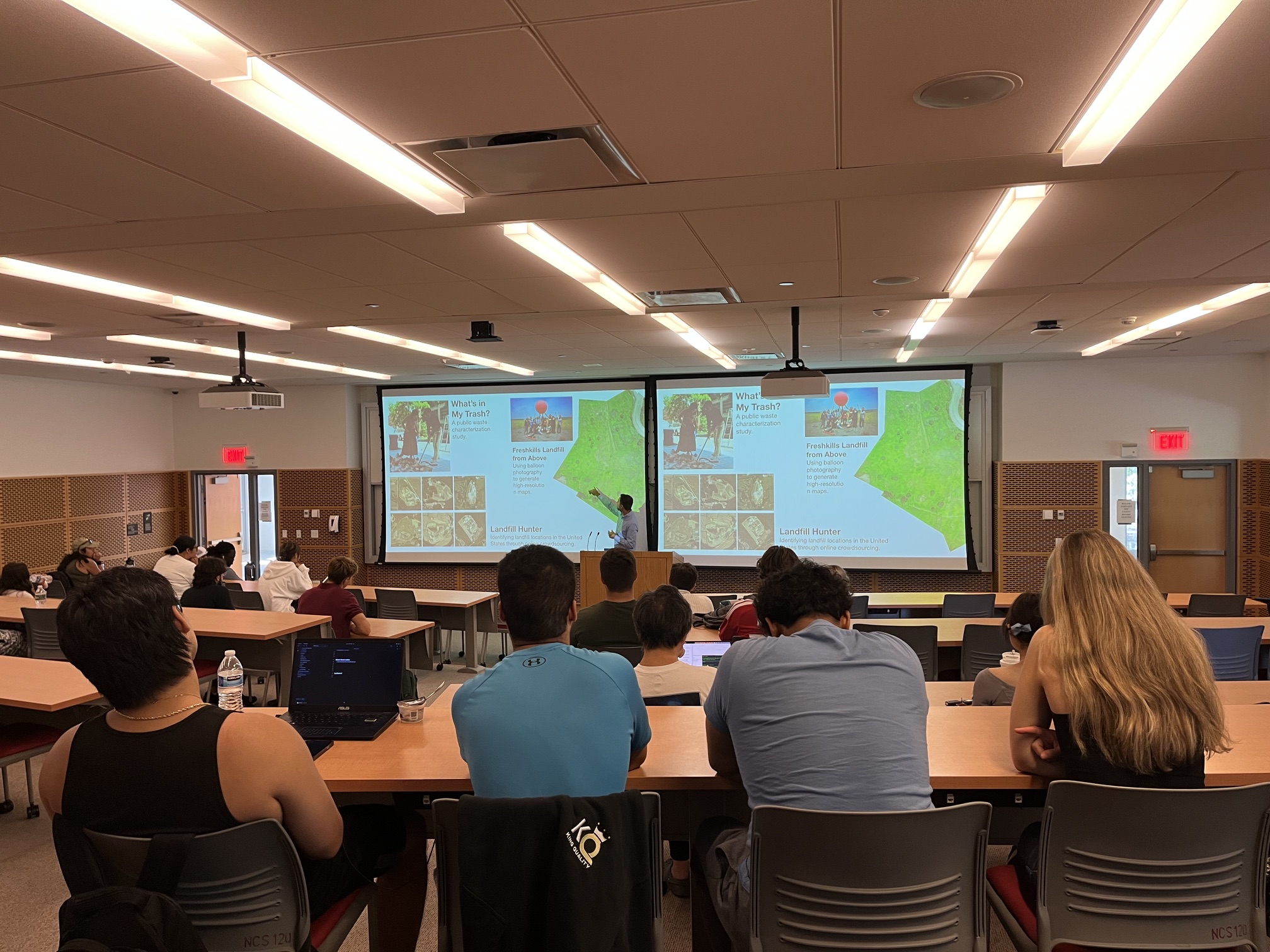
The seminar speakers covered AI-related research topics, technical tools, research methodologies, and ethics and protocols to support students in their work. They also discussed AI safety, ethics, and AI for the public good.
The mentors’ in-depth perspectives on AI and industry initiatives prepared students to work on a project individually or collectively within a research area of their interest. At the end of 6 weeks, they presented a poster summarizing their research during the program.
Lav R. Varshney, Della Pietra Infinity Professor and Director of the AI Innovation Institute at Stony Brook University, said, "The AI Innovation and Diffusion REU program helped create a foundation for Long Island undergraduates preparing to join today's rapidly evolving workforce. The research insights presented across the six weeks of the program and at the symposium were the sign of a growing intellectual community that understands not only how their fields can advance with AI, but also how to build, evaluate, and improve these systems."
Some of the projects include:
- Mapping Eight Decades of Long Island Land-Use Change with AI
Working from the Stony Brook University Libraries' Historical Long Island Aerial Photography Collection — nearly 700 black-and-white images — the team set out to measure how the region has expanded over the years. Frames from 1938, 1947, and 1970 were georeferenced against present-day landmarks, then passed to Gemini, which generated land-cover masks separating urban ground, roads, and open land. Across three study areas near Northwest Harbor, the team noticed that urban cover rose from 8.5 percent in 1938 to 33.3 percent in 2025.
- Scalable Detection and Reblocking of Informal Settlements
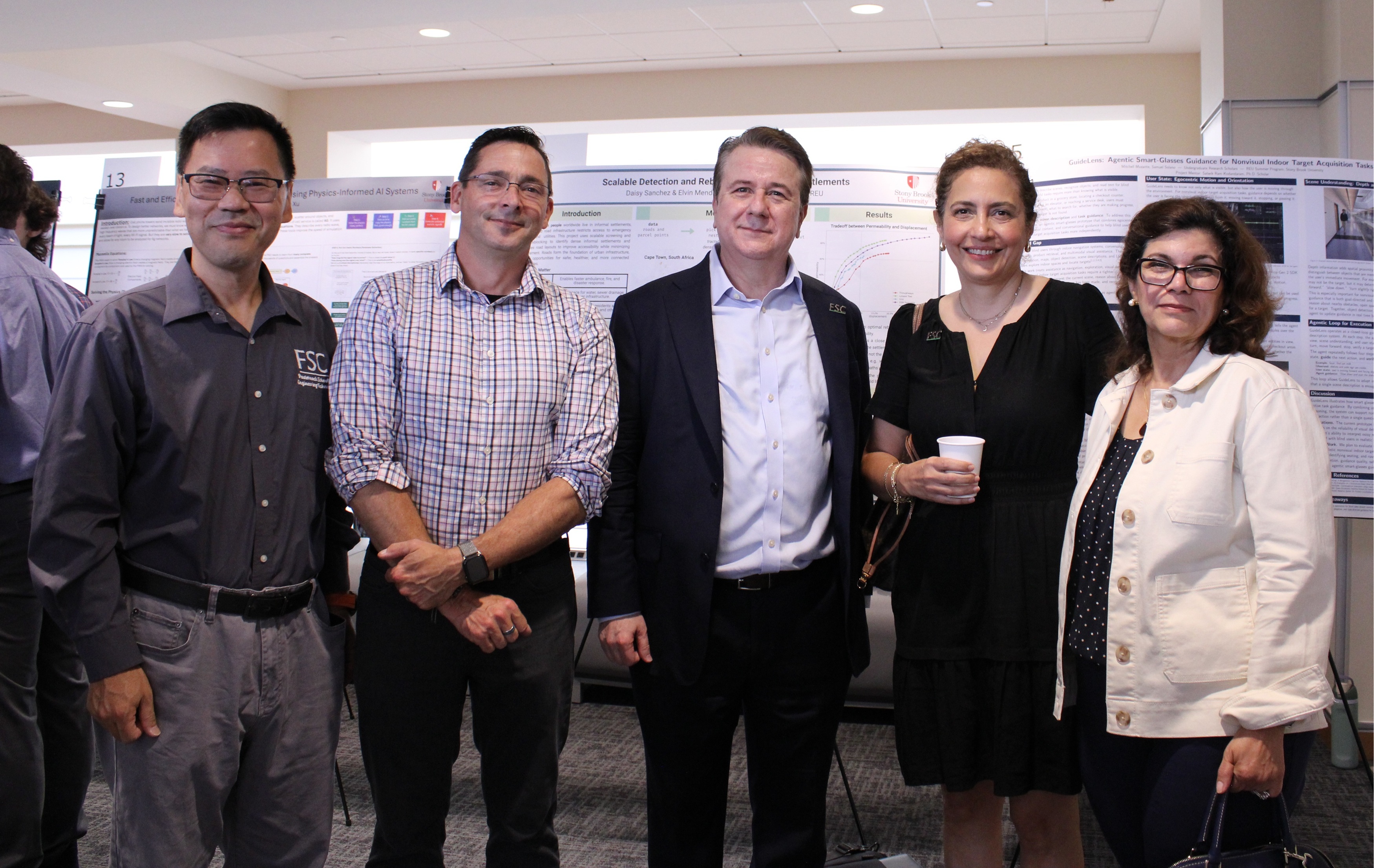
Nearly 1.1 billion people live in informal settlements, where the absence of road infrastructure limits access to ambulances, water, and power. Sanchez (Farmingdale SC) and Mendoza (Suffolk CC) built a framework that scored over 83,000 blocks in Cape Town, identifying the densest areas in the region. It then compared four ways of building new roads along these settlements, finalizing one that would cause minimal displacement. Their project has the potential to support data-driven decision-making for safer, accessible, and more resilient communities.
- Random Forest Classification for Improving CT Lung Lesion Diagnosis
Low-dose CT screening identifies several lung nodules that cannot be definitively called benign or malignant, and each ambiguous result may mean further scans or a biopsy. Using data from the National Lung Screening Trial, the team tested whether reconstructing scans at multiple energy levels reveals tissue characteristics that standard CT cannot. Their method sorted cancerous nodules from harmless ones far more reliably — 31.33 percent better than the conventional approach.
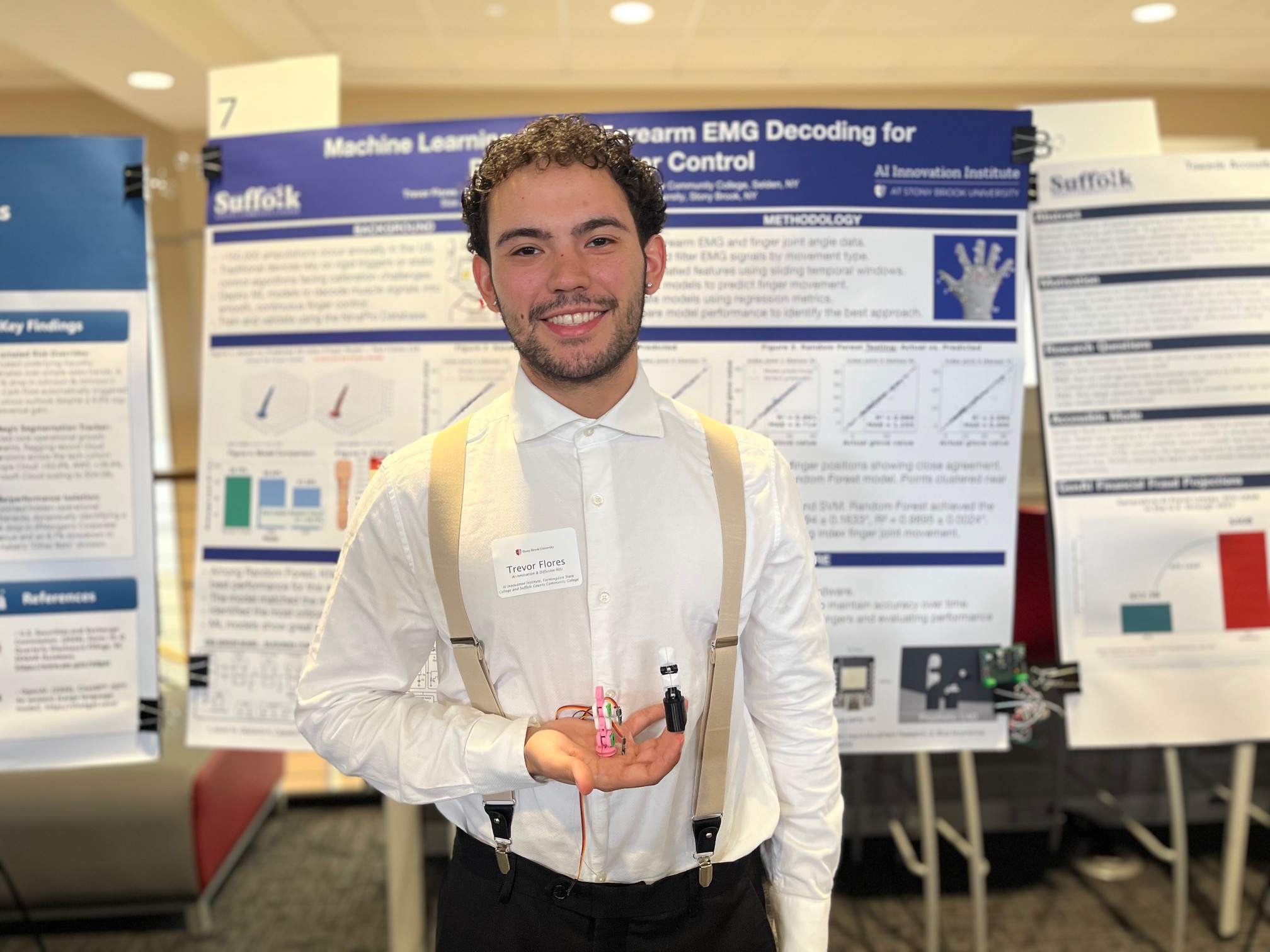
- Machine Learning-Based Forearm EMG Decoding for Prosthetic Finger Control
Around 150,000 amputations occur annually in the United States, and many prosthetic hands still rely on rigid triggers rather than continuous control for movement. Flores (Suffolk CC) trained models on a database of forearm muscle recordings paired with finger joint angles, extracting features across time windows to predict finger movement using a variety of models. Of these, Random Forest tracked measured index-finger positions most closely, and the analysis identified which sensor placements matter most — a practical finding for hardware yet to be built.
- GuideLens: Agentic Smart-Glasses Guidance for Nonvisual Indoor Target Acquisition Tasks
Smart glasses can already tell a blind user what’s in front of them. But finding an object, like a carton of oat milk in a grocery store, requires something else: knowing whether the person is approaching the shelf, has walked past it, or needs to turn. Muzante and Solano from Farmingdale SC built a prototype that pulls position, heading, and motion from a Meta, combines it with object and depth detection, and runs a continuous directive loop — observe, update, guide, verify — rather than issuing a single description.
- AI-Driven Reconstruction of SolidWorks Models from Engineering Drawings
Converting a legacy engineering drawing into an editable 3D model remains largely manual work. Scott (Farmingdale SC) tested whether AI could read a drawing and return structured instructions — a constrained JSON description of sketches, extrusions, and cuts — that a Python builder can then validate and execute. He noticed that it was easy for AI to recognize shapes, but it had difficulty preserving dimensions, feature order, and engineering intent. Scott’s future work will focus on improving this consistency, adding more design types, and building an automated verification and correction loop.
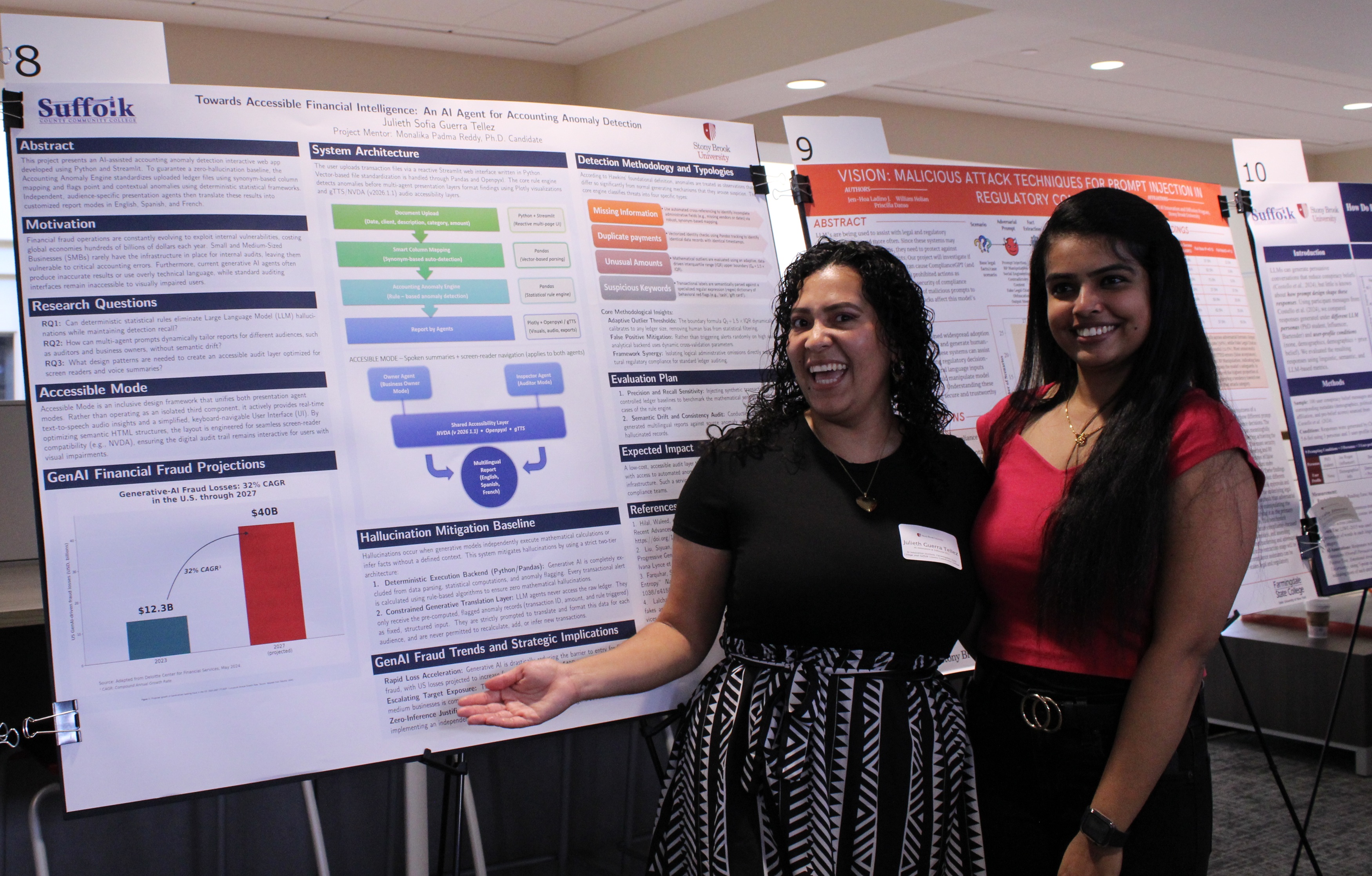
- Towards Accessible Financial Intelligence: An AI Agent for Accounting Anomaly Detection
Small businesses rarely have the infrastructure for internal audits, and generative tools that might help are prone to inventing figures. Guerra Tellez (Suffolk CC) built a web application that keeps the two functions strictly apart: one flags duplicate payments, unusual amounts, missing fields, and suspicious keywords, while language models see the flagged records and explain them — in English, Spanish, or French.
- Do we speak the same language: How Humans and LLMs Communicate via Dialogue Acts: A Pilot Study
Cazarin-Orellana and Garofalo from Farmingdale studied how differently humans and LLMs collaborate amongst themselves. They hand-coded 757 turns of both kinds of dialogue (Human-Human and AI-AI) to learn how they tracked what others understood and resolved differences via questions. The AI pairs were more verbose and repetitive. And they asked narrow yes-or-no questions, whereas humans asked open ones — a hint that machine conversation may not fit the categories built to describe our own.
Professor Jerome Liang, who heads the Laboratory for Imaging Research and Informatics (IRIS) at Stony Brook, said, “Machine learning (ML) plays a critical role in problem-solving for non-invasive medical imaging-based diagnosis. Under the supervision of mentors, our undergraduate students applied existing ML methods and other computational strategies for the early detection of lung cancer. Through this project, they learned how imaging devices work, how to study the images they produce, and how AI can be used to characterize tissue pathology and health conditions.
“They also developed an understanding of the overall structure and workflow of an ML-based medical imaging project, including data preparation, feature analysis, model development, and evaluation. These experiences broadened their knowledge of the subjects, providing a foundation for independently exploring research topics wherein AI/ML can be used for problem-solving.”
Geoffrey Churchill, a Ph.D. student in the Department of Computer Science, mentored students at the NCS Lab in Data Science under Professor Steven Skiena. "My mentees and I had a great time in the program. The students were very dedicated and spent a lot of time in the lab, so they got to know each other, my labmates, and others in the REU program. The limited timeframe pushed us to focus on getting an MVP running as soon as possible, and we were able to build something functional we could iterate on."
Trevor Flores, an undergraduate from Suffolk Community College, said, "I had an awesome experience at REU. The experience shifted my worldview by making me more comfortable approaching unfamiliar problems without knowing the answer. At the beginning of the program, I had imposter syndrome. I didn't understand how AI worked, let alone build it. Instead of seeing these things as daunting, I now see them as an opportunity to experiment, learn, and figure something out. I feel more confident having seen and learned how AI can be used to create technology that has a real impact on people."
When talking about his project, Flores adds, "Working on the prosthetic finger project showed me how different areas of engineering can come together. My amazing mentor, Size, taught me to work with machine learning, electronics, sensors, programming, and designing prototypes. A project that would normally require a team, I was able to do all by myself with the help of AI. I even learned things AI could not do, which forced me to be better at practical applications. Having the freedom to work with Size on a subject of my choice was incredible. At one point, he supplied me with his own hardware to help me work on other projects. I'm grateful to have met someone who believed in my ideas, gave me the freedom to explore them, and continues to support me."
JackelineCazarin-Orellana, a student from Farmingdale State College, said, “I came into the program thinking I would be swayed into using AI more frequently, as everyone fears it will take over our jobs. Now I’ve realized its limited ability to generate new ideas. AI is only as smart as the data it is fed, and I am assured that it cannot do what humans do. I really enjoyed my time in the REU program, as I learned a lot from my mentor Amie, as well as the seminar speakers. I believe I picked up lifelong skills, specifically in professionalism.”
Irina Viscun, Business & Office Coordinator at the AI Innovation Institute, said, "The REU in AI Innovation & Diffusion offered undergraduate students a wonderful platform for experiencing cutting-edge research in AI. Students and mentors came from a range of academic disciplines to create a research environment in which, for some, these disciplines were in conversation for the very first time. This interdisciplinary mix made the research work challenging, but over the course of the program, that challenge revealed itself to be a singular opportunity.
The posters and presentations at the summer symposium testified to the successful integration of their individual and collaborative research efforts into a larger network, advancing the field of Artificial Intelligence in Stony Brook, New York State, and beyond."