
For James Glimm, Distinguished Professor in the Department of Applied Mathematics and Statistics at Stony Brook University, creative ideas come gradually and at unexpected times.
“I see the idea like a cloud in the distance and then it takes shape,” said Glimm, who at 92 still works whenever an idea strikes, even late into the night. “Thomas Edison slept a little and worked and slept a little and worked,” he said.
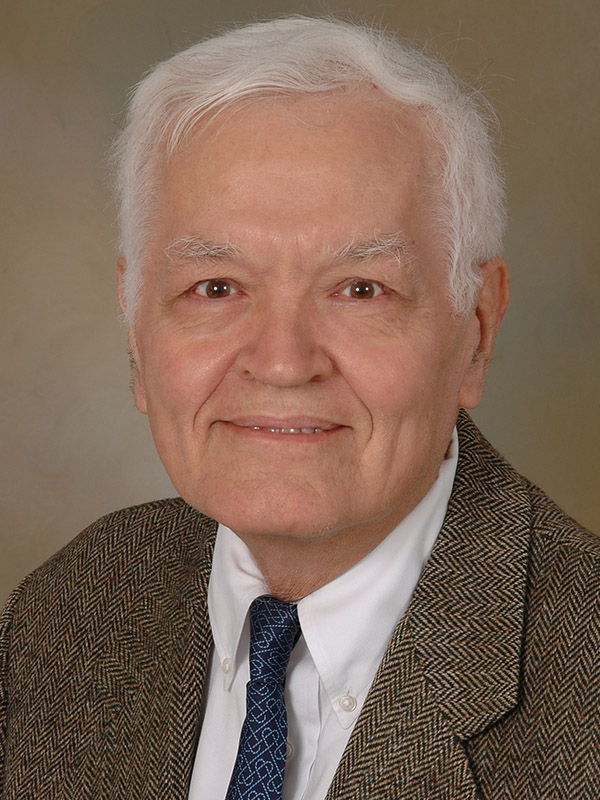
Glimm is one of several mathematicians who were surprised to hear the announcement on September 8, 2026, that Open AI had solved the Navier-Stokes problem that has challenged his community for years. He and his joint author, Jarret Petrillo, were working on it. “Of course it was a disappointment, but I did not waste a lot of time on this. Rather, I’m picking up the pieces and moving on to the future.”
Glimm has made major contributions to nonlinear analysis, quantum field theory and computational fluid dynamics, and has been studying turbulence for “a number of years,” he said. “I thought of extending some standard methods, but that did not work out,” said Glimm.
The Navier-Stokes problem is one of the seven Millennium Prize problems introduced in 2000 by The Clay Mathematics Institute in Paris. The solutions to each of the seven problems could help mankind develop new structures and methods. Developed by Claude-Louis Navier and George Gabriel Stokes in the 19th century, these mathematical formulas apply Newton’s second law of motion to continuous fluids like water and air.
The Clay Institute would award $1 million for whomever solved any of the Millennium Prize Problems. Up until this point, only one problem – the Poincaré conjecture – has been solved and that was in 2003 by Russian mathematician Grigori Perelman (who was a postdoc in the 90s at Stony Brook), though he declined the prize money.
In regard to the Navier-Stokes problem, Open AI estimated at its press conference that it would cost approximately $15 million of compute power for a company to solve this problem.
Glimm rattled off a list of some engineering instances where the study of turbulence can positively affect an array of challenges to mankind. They include: cardiac fibrillation, the engine of a scramjet, and the erosion of soil in the pillars of a bridge over a river.
He recalled that “the famous Tacoma bridge collapse in the 1940s resulted from turbulence setting up vibrations in the supporting cables, and the famous John Hancock Tower in Boston’s shattering of glass panels resulted from stresses coming from wind shear at the corners of the building in the 70s.” He added, engineering guidelines come from correcting past mistakes.
For the past two years, Glimm has been focusing his attention on the “blowup in finite time.”
“During turbulent blow-up, spherical harmonic modes transform from turbulent to non-turbulent forms, with the process of occurring a finite number of times before completion,” he explained. He completed between five and 10 papers which document aspects of the finite blowup. “The present paper’s framework has been fixed for about a year,” he said.
“Then there is the matter of detecting flaws in the proof and removing them. Some were found by human examination — ourselves and colleagues — and some were found by a high level proof analyzer that Petrillo used,” said Glimm.
“Our proof is very different, and illustrates different aspects of the theory of turbulence,” he added. “The proof is also short, 8 pages or so, in contrast to the AI generated proof, written in text format, probably nearly 100 pages. So our proof is maybe one humans will enjoy and remember.”
Glimm takes the historical perspective when speaking about AI, likening it to the technological revolution. “Like the weaving machines that replaced weavers, this is a new chapter and it is coming at the speed of light,” he said.
“The Navier-Stokes story also points to a distinction between problem solving and problem finding. AI may become extremely capable at solving mathematical problems, but somebody had to formulate the problem first,” said Lav Varshney, Della Pietra Infinity Professor and inaugural director of the AI Innovation Institute at Stony Brook University. “I think that part of science will remain deeply human for some time.”
Glimm lives in Manhattan with his wife of almost 70 years, Adele, an author. They met at Columbia where he earned his PhD in mathematics and contributed to both pure and applied mathematics. He wanted to study mathematics, engineering and physics, but realized in graduate school that he had to choose one.
“It was a life lesson,” he said. “To go deep, you have to go narrow.”
Early in his career he went deep into work in the theory of operator algebras and the work was groundbreaking. Today the “Glimm algebras” continue to play an important role in this area of research.
In mathematical physics, Glimm worked on problems in quantum field theory, quantum statistical mechanics, shock wave theory and scientific computation. He served as chair of the Department of Applied Mathematics and Statistics at Stony Brook University and established the Center for Data Intensive Computing at Brookhaven National Laboratory. He has also taught at MIT, New York University and the Rockefeller University.
“Jim has been one of the most influential mathematicians of our era. He sees connections that others do not, and this ability has led to his widely recognized contributions in diverse areas. He has long served as a mentor and a motivator for students, postdocs, and junior faculty,” said Joseph Mitchell, chair of the Department of Applied Mathematics and Statistics.
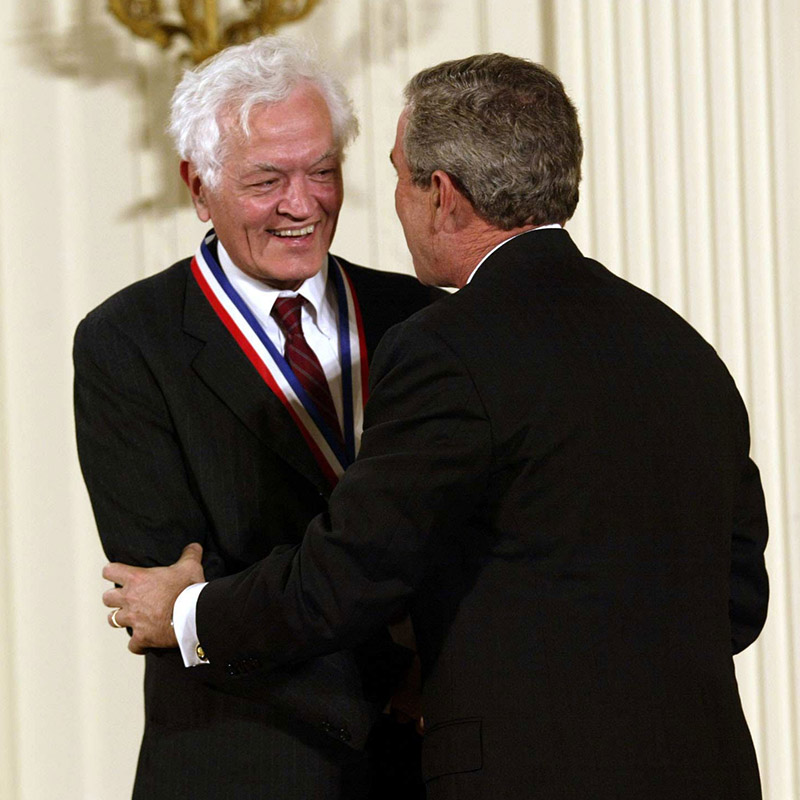
His honors include the New York Academy Prize in the Physical and Mathematical Sciences (1979), the Dannie Heineman Prize for Mathematical Physics (1980), and the American Mathematical Society’s Steele Prize for a Seminal Contribution to Research (1993). He was elected to the National Academy of Sciences in 1984. In 2002, he received the National Medal of Science, the country’s highest honor for research in mathematics and science.
“AI is a profound change on the structure of human beings and their lives. This is a new chapter,” said Glimm.
Some of Glimm’s heroes are John von Neumann, Henri Poincaré, and Jürgen Moser. He approaches life like he approaches science: “Go deep at any point in your life, go narrow and deep, and if you don’t like it, you go deep again.”