

Stony Brook, NY, Nov 23, 2026 -In a groundbreaking initiative, Stony Brook University's AI Innovation Institute partnered with OpenAI to study how working with artificial intelligence (AI) impacts human creativity. Building such scientific evidence is crucial to designing the future of education and workforce development.
The research, led by Stony Brook’s Postdoctoral researcher Babak Hemmatian and AI Innovation Institute Director Lav Varshney, drew the attention of Ronnie Chatterji, OpenAI's Chief Economist, and Rachel Brown, former Economic Strategist at OpenAI. Through the partnership, OpenAI researchers gave insights on study design, provisioned frontier AI resource access to Stony Brook students in an equitable manner, and offered significant credits for the research team to perform AI-driven data analysis.
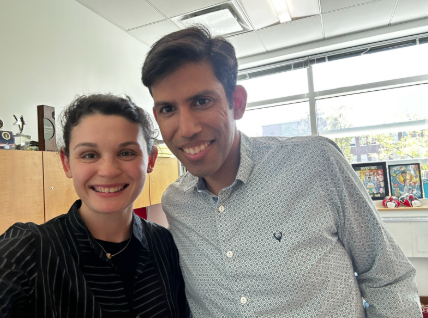
Chatterji said, “These studies are important for understanding how AI can be used in education and the workforce. We want to make sure universities have the tools they need to study these topics, which is why we were excited to work with Stony Brook. It’s also great to see classes like AI and Creativity being offered.”
Varshney said, “With AI advancing rapidly in industry, it is important for Stony Brook to remain at the frontier through direct engagement with leading companies. As part of this global AI ecosystem, we are developing a scientific basis for how AI can most effectively uplift human creativity, which is poised to be the most important question for teaching and learning in our age, and a critical factor in how AI is best deployed in numerous societal contexts.”
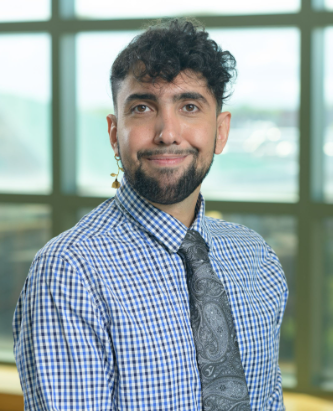
Sharing the research premise, Hemmatian said, “We wanted to study how working with AI in a collaborative context changes the quality and originality of ideas we come up with. Where is AI’s place in the creative process? Is it from the conversation, from the ideas the machine contributes, or from something the person does better because the machine is there?”
To conduct the study, the team brought the initiative into Stony Brook's ‘AI and Creativity’ class, taught by Matthew Salzano, an Assistant Professor in the Department of Communication and an AI3 affiliate faculty member.
Rachel Brown visited as a guest lecturer, highlighting how gen AI is being adopted faster than any technology in human history. Her talk drew on insights from OpenAI Signals, a public data platform tracking real-world AI usage, and shared how AI is rapidly shifting from casual information-seeking to active, complex co-creation across education and the broader workforce.
Brown discussed OpenAI’s education research initiatives, as well as the organization’s interest in projects that implement innovative research designs and address new questions. At the end of the session, the nearly 500 students in Salzano’s class were given full access to OpenAI’s frontier models as a live learning grant, turning the lecture hall into a space thriving with human-AI co-creation.
The students were given paired assignments in the class and a separate assignment to take home. The task: go over given information about a company and create a Vision statement.
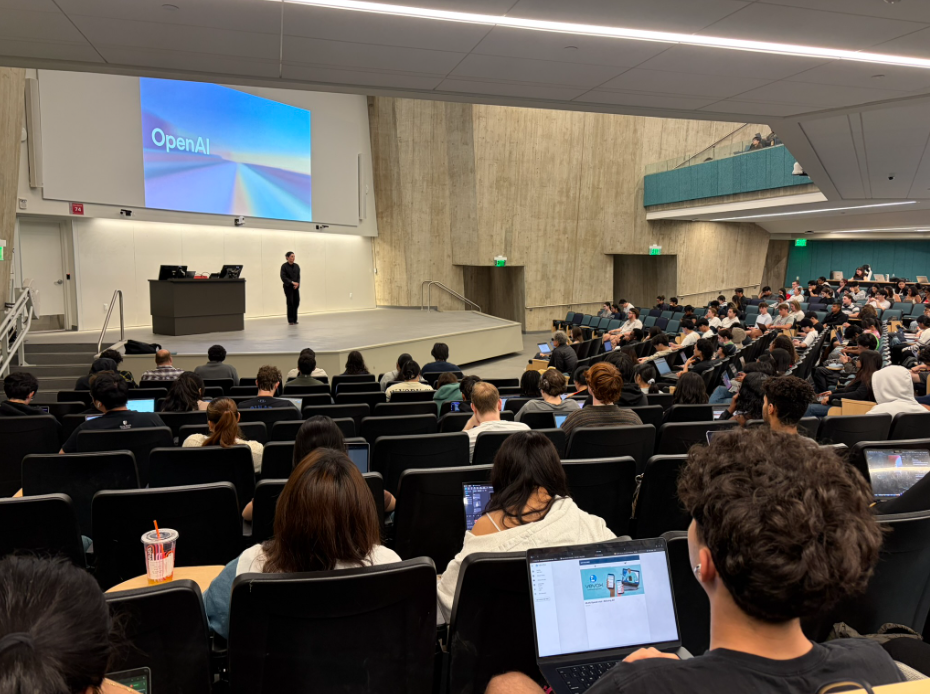
Sharing the students’ experiences, Salzano said, “In addition to providing students a chance to use an advanced version of ChatGPT, an incredibly valuable part of this partnership for students was Brown's visit to COM107. Her conversation with the students was a testament to how productive dialogue about AI and Creativity doesn't avoid difficult questions around how it will change careers, culture, and communication for better and for worse. I believe the students walked away from this collaboration with a more nuanced understanding instead of uncritically following popular hype or doom perspectives on AI.”
A few months later, while the research on AI and Creativity progressed to its next stage, Varshney was the only professor invited to speak at the OpenAI Forum on Building the Future of AI in San Francisco. The event brought together global leaders across science, health, national security, policy, civil society, and AI to identify pressing challenges frontier AI could help address and work through practical questions in solving them together.
“It was really meaningful to join the global conversation. I told the assembled experts from within and outside OpenAI about simultaneously human- and formally-verifiable techniques such as information lattice learning that move beyond large language models, as well as new approaches to AI safety that work completely agnostically to the rapidly-expanding capabilities of AI models,” he said.
Combining cutting-edge technology and rigorous empirical design, Stony Brook University and OpenAI are setting the stage for a new era of educational research — one that moves beyond mere anecdote and speculation to establish scientific foundations for how humans and artificial intelligence can best think, learn, and create together — focused especially on the human side of the equation.