

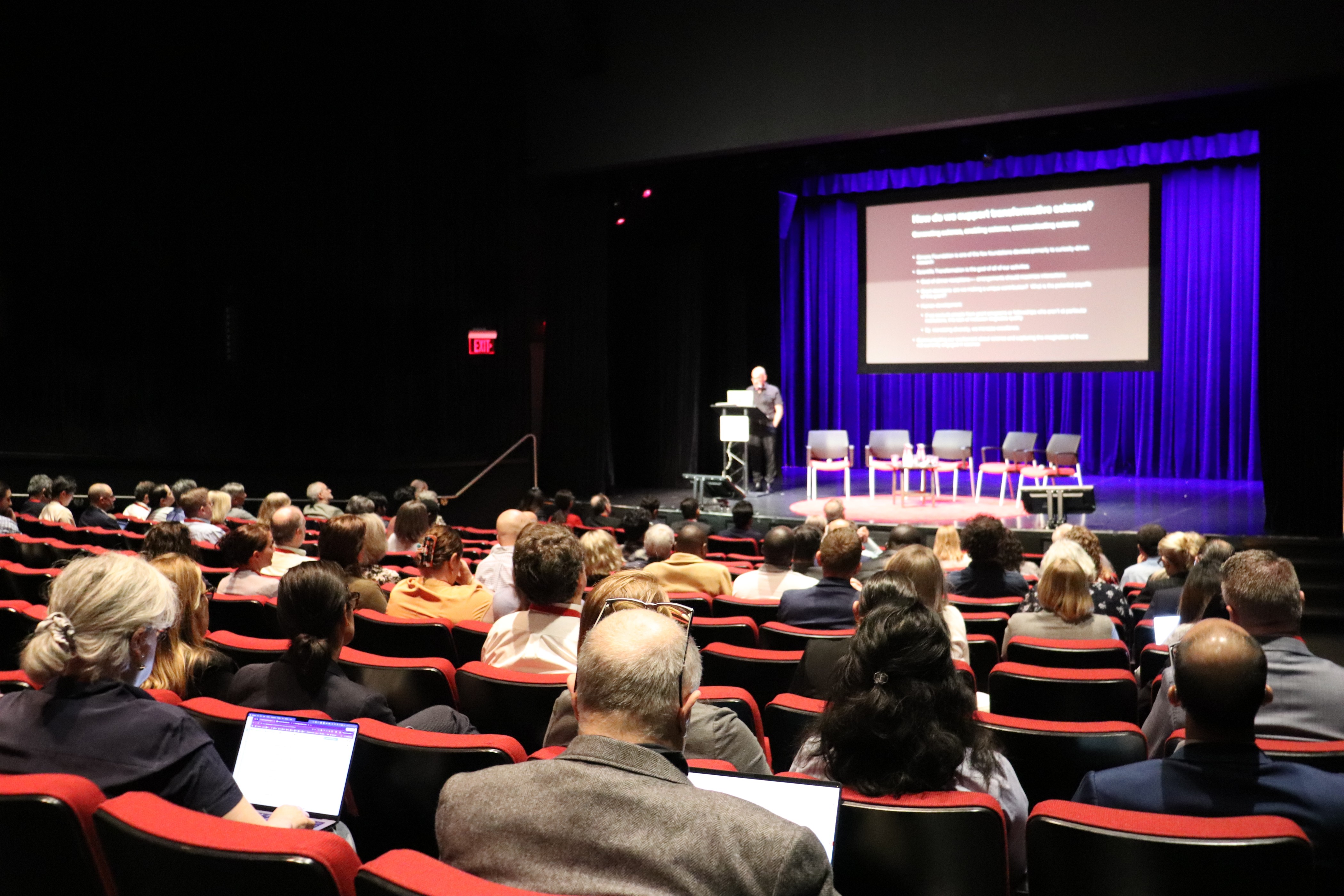
Stony Brook, NY, 30th April, 2026 — On April 14 and 15, the SUNY AI Symposium at Stony Brook brought together pioneers of the AI world who do not often occupy the same room. Educators, scientists, founders, policymakers, students, and artists across New York convened at Stony Brook’s Charles B. Wang Center, sharing insights and building a vision for AI research, education, and full-scale integration.
SUNY Chancellor John B. King Jr. said, “This is a room full of people who deeply grasp the enormous potential of AI as well as its challenges. As you have conversations across every corner of the AI landscape, I challenge you to challenge your assumptions, especially in a field as dynamic as AI.
Decades, centuries, generations from now when we think of the development of the next generation internet, next generation computers, the next generation of treatments and cures or diseases discovered with AI, the names State University of New York at Stony Brook and SUNY will be top of mind. That will be thanks to the folks in this room.”
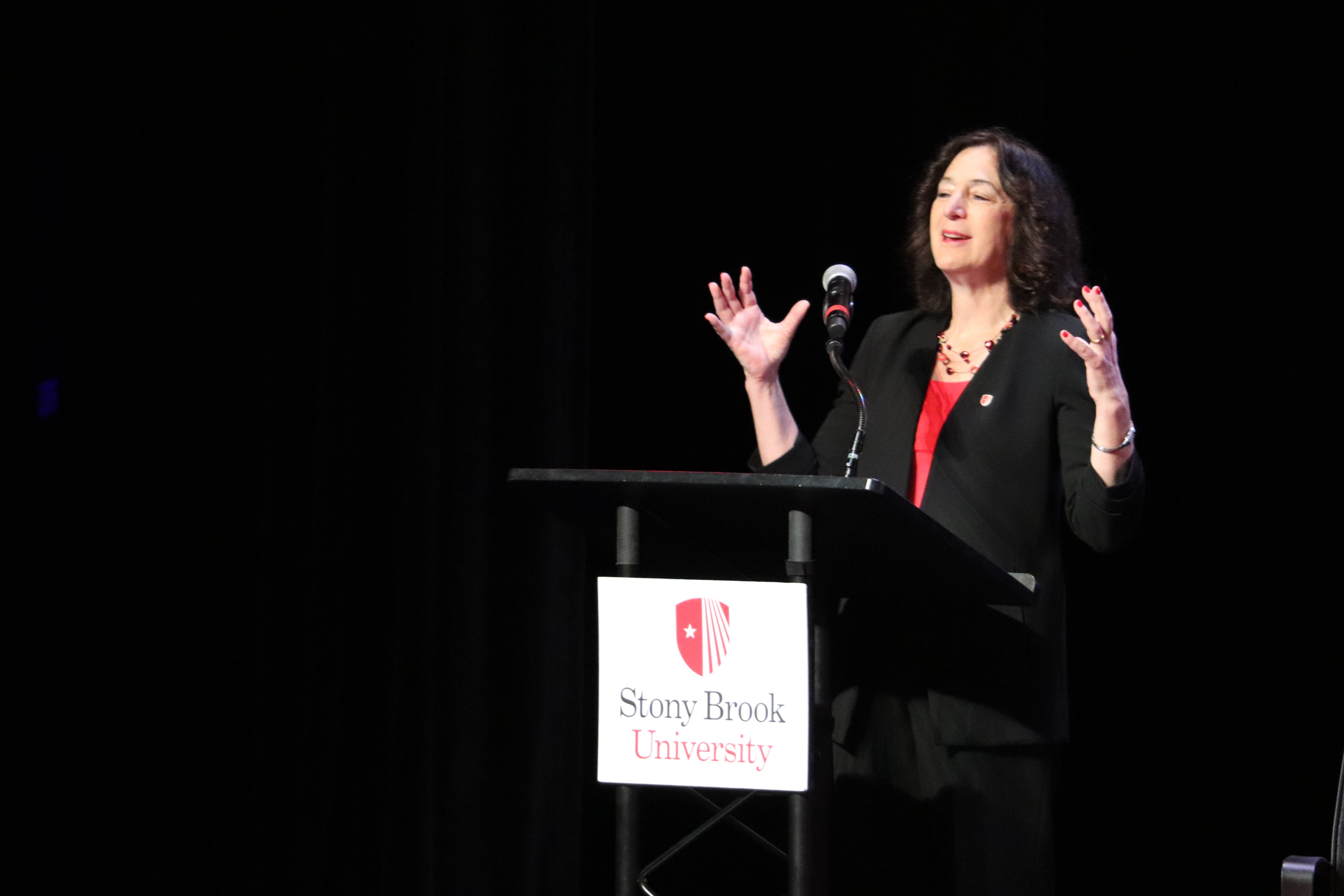
Stony Brook President Andrea Goldsmith welcomed attendees with enterprising remarks, “I speak for all of our students, faculty, and staff when I say that we at Stony Brook are incredibly proud to be hosting this symposium. This is an opportunity for our community to showcase bold ideas and discover new ways for responsibly accelerating and integrating AI into our research, as well as our education; to use it in industry, the arts, and the humanities; and to use it to benefit society as a whole.”
The opening panel, “The Empire State’s Intelligence: Mapping New York’s AI Future,” widened the frame beyond SUNY Stony Brook. Moderated by Jeff Jarvis, visiting professor in the School of Communication and Journalism at Stony Brook, it brought together Michael Carpenter of SUNY Polytechnic, Jason D’Cruz of the University at Albany, Sharon Moran of SUNY ESF, and Shiqi Zhang of Binghamton University.
The conversation spanned New York’s approach to artificial intelligence, highlighting ongoing and upcoming research, innovative ways of teaching and implementing AI at scale, stories about how students are learning and using AI, and its impact on the job market. The discussion also surfaced a range of concerns over accountability, ethics, transparency, and trustworthiness.
Carpenter said, “AI is already affecting every possible discipline, institution, and sector of society. So everybody should be in on the conversation at that level. There are calls for wider democratization of that conversation, and universities should be a place for that. It’s also important to see that AI fundamentally forces us to reconsider our definitions. What is intelligence? What does learning mean? How do you define creativity? This is a great opportunity to reexamine what we’re doing.”
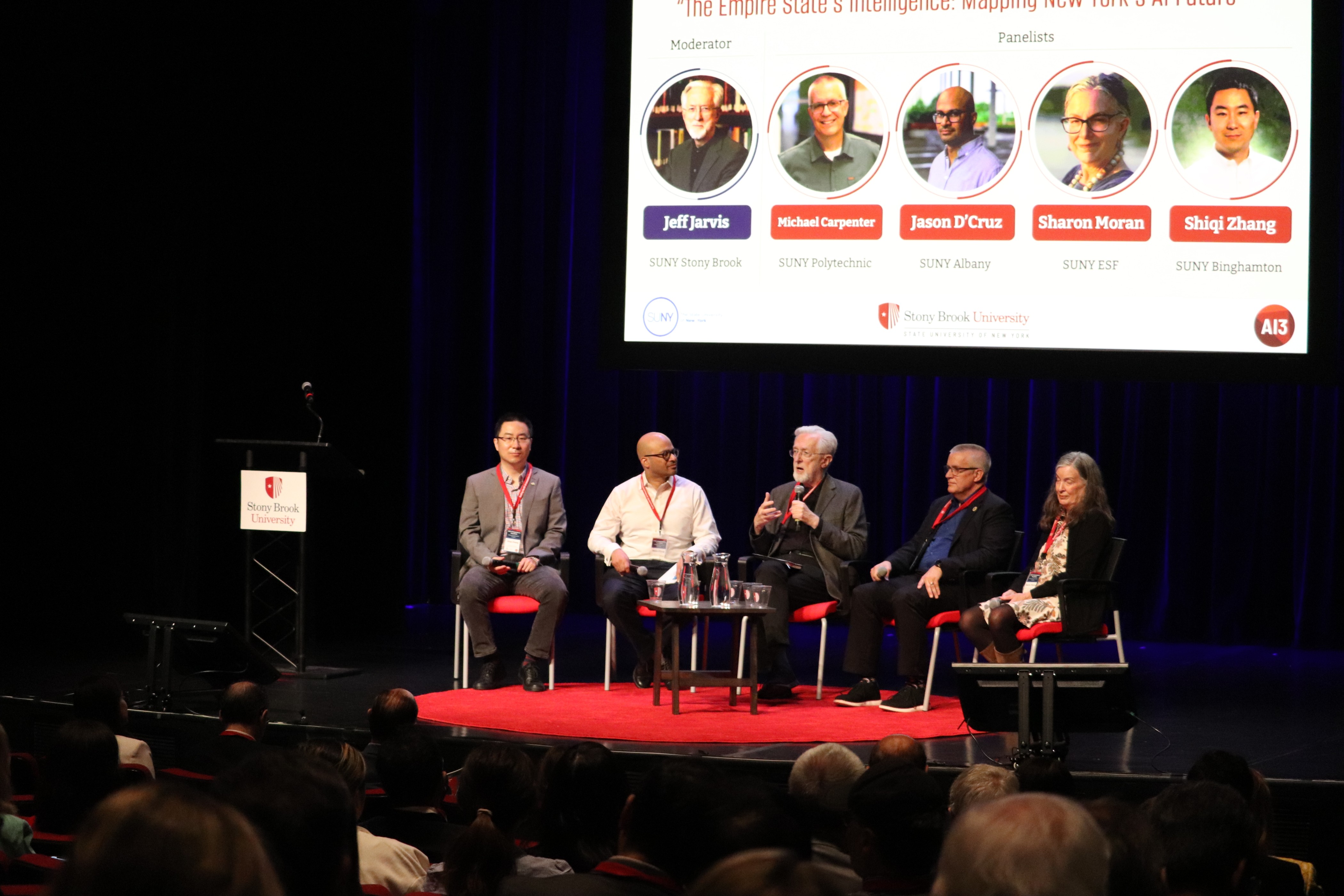
The panel set up a precedent. AI should not be treated as a monolithic field, but as an ecosystem of experts with different intellectual strengths and attentive approaches to interacting with AI. It seemed one thing to discuss New York’s AI future, and another to build one that welcomes diverse research cultures with a singular underlying mission — public good.
Another session, “The Multiscale Intelligence: AI’s Role in Understanding Life Across Disciplines,” shifted the conversation toward research. Moderated by Dr. Anisha Kumar, M.D., assistant professor of surgery at Stony Brook Medicine, it brought together three Stony Brook researchers whose work sits at varying levels of biological inquiry: Ivet Bahar, who studies the molecular dynamics of living systems; Heather Lynch, whose work uses statistics, remote sensing, and imagery to understand ecological change; and Joel Saltz, a pioneer in computational medicine and digital pathology.
Seen side by side, their work made a compelling argument that AI is not just a tool for one corner of science. It is being taught to move across scales — from molecules to cells and tissues to ecosystems — and to manage forms of complexity that are increasingly impossible to handle manually.
Lynch, professor in the Department of Ecology and Evolution at the College of Arts and Sciences, said, “One of the things we played around with was for annotating images. Say you have a video of throwing a ball through the air, and you ask AI where the ball is, it's really helpful if the AI knows something about gravity and mechanics.
“We're trying to use the same concept. The problem we have is very small training data sets. So we bootstrap that with our understanding about the dynamics of what a penguin colony could possibly be doing from one year to the next, along with some hard constraints. The way we understand the physics of how proteins fold, for example, we can employ guard rails to help AI to solve such cases.”
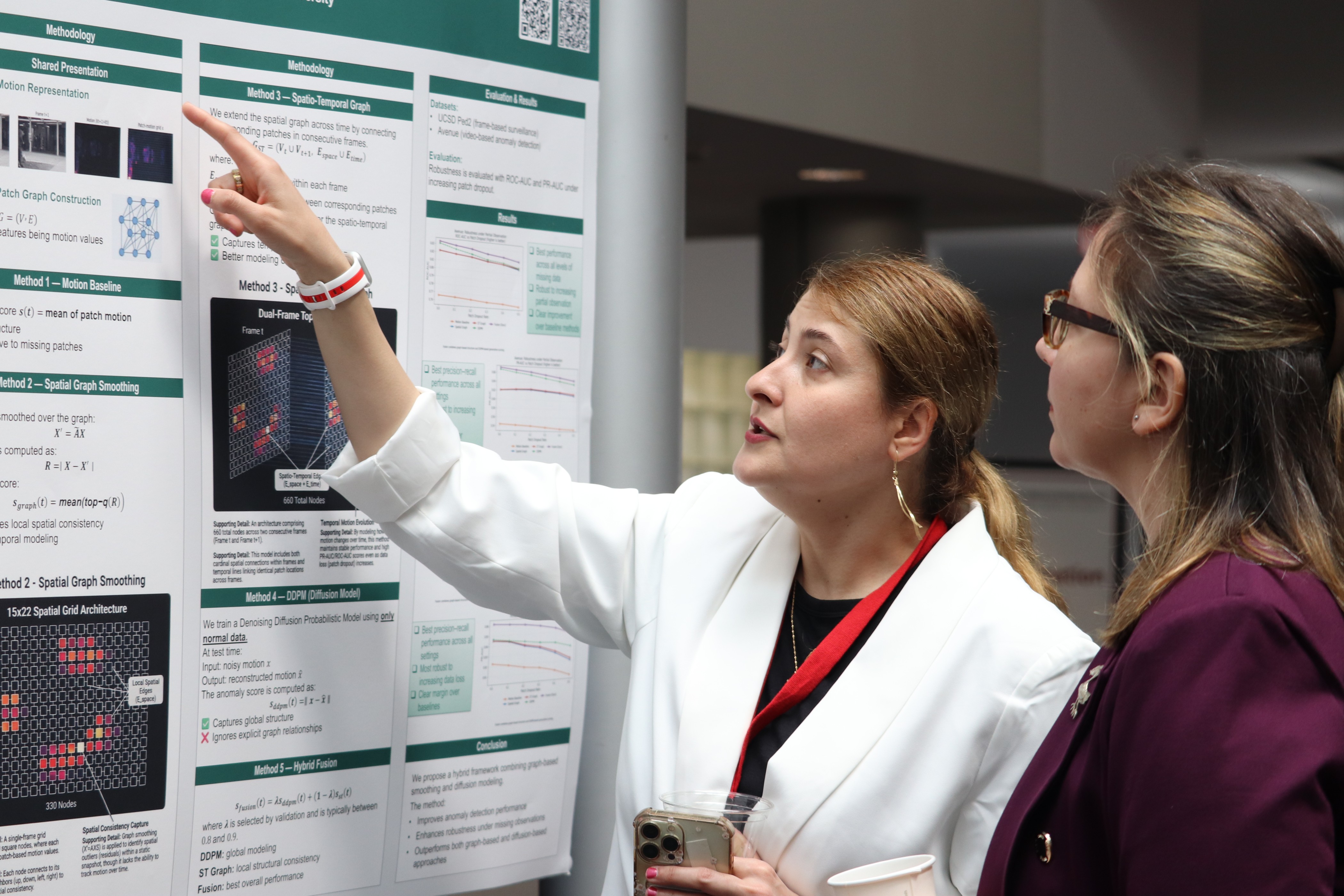
That scientific adaptability had a visible counterpart in the poster session. “A Showcase of SUNY’s Next-Gen AI Talent” highlighted the work of students and researchers across New York state. They ranged from AI-supported health science education and political bias in AI search engines to autonomous weather sensing, the hidden energy cost of scaling hardware, robotics, and human-AI co-creation. Some projects were deeply technical, others overtly industrial. Together, they suggested that AI work across the state is already happening in dozens of forms at once, guided by experts who are asking the right questions.
Conversations slowly returned to systems and strategy. A session on compute, energy, and people infrastructure foregrounded a reality that often gets flattened in public AI discourse — models do not scale on theory alone. They require power, storage, networks, policy, and skilled people. Later, a session on “The Global Race: AI as the Engine of American Strategic Advantage” turned that infrastructure outward, into the language of geopolitics and national capacity.
Moderated by Lav Varshney, Della Pietra Infinity Professor and director of the AI Innovation Institute at Stony Brook, the panel featured Kristen Ellis of the U.S. Department of Energy, Stony Brook President Andrea Goldsmith, and Jamie Metzl of OneShared.World.
Stony Brook President Andrea Goldsmith said, “I believe that AI is a powerful tool that we need to figure out how to harness for good. I don’t think we can keep up with the speed at which it’s evolving, so we need to build self-policing into this technology. But human intelligence is truly unique. Creativity, vision, instinct, perspective, collaboration, emotion, compassion, these are things that AI just cannot do. And so how we take this powerful tool and merge it with what’s uniquely human. This is part of what the challenge is about.”
Ellis, associate principal deputy assistant secretary for the Office of Regulatory and Policy Affairs at the U.S. Department of Energy (DOE), added, “I think there are a lot of potential partnerships in AI research — the existing collaborations already tied to our user facilities, and the scientific research investment from other countries. Not everybody can build a supercomputer, so we also need to share what we have and catalyze what comes out of those things together. And we’ve got to balance the geopolitical impacts as they happen and continue to build our allies and partners with shared goals.”
Ellis also highlighted the DOE’s Genesis mission, a national initiative to build the world’s most powerful AI-driven scientific platform. Its goal is to create 100,000 AI-ready scientists and double the productivity and impact of American R&D within a decade.
The second day opened with a more focused outlook. The program highlighted SUNY STRIVE, science philanthropy, and education.
College of Engineering and Applied Sciences Dean Andrew Singer said, “One of the most exciting aspects of the STRIVE AI task force was to reach out to all of the colleges and all of the departments across the entire Stony Brook platform and engage people in a discussion around where we will go with this technology. What can we offer to our students? And how can we build something that isn't just a sub-discipline of computer science but rather a platform for education and engagement?”
David Spergel, President of Simons Foundation, said, “Philanthropic and nonprofit funding has grown a lot since the 1990s. There's a lot of interest in AI, and many opportunities to bring in new philanthropy. Now this chart shows the breakdown in science funding for basic research. As you can see, Federal is an essential part of the pie. And I think one of the many exciting aspects of Empire AI is the very significant state commitment that has enabled that project and the partnership between universities across the state.”
These questions compelled experts to answer, “How, exactly, does AI move from the lab into the classroom, the workplace, and the culture around us?”
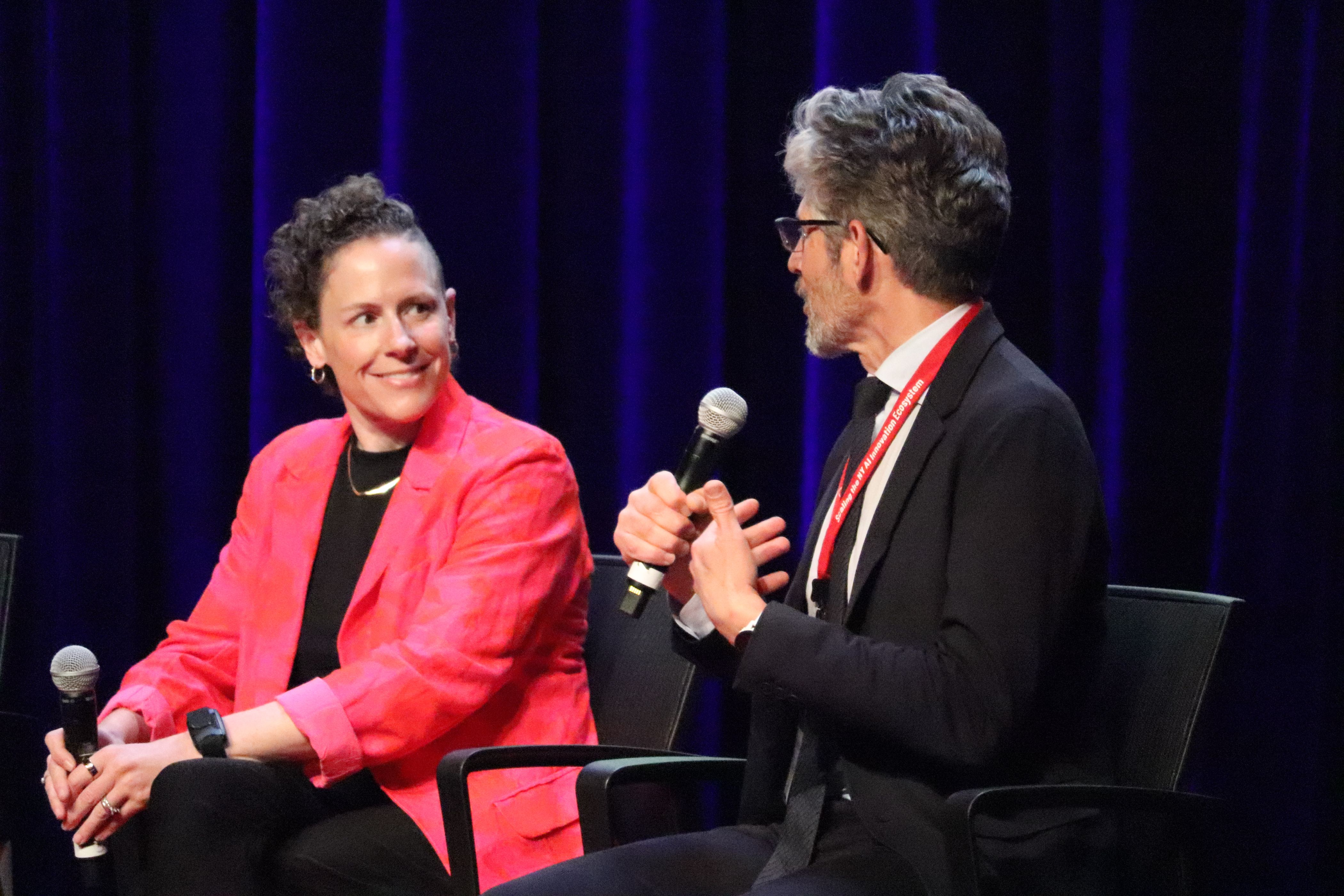
That inquiry came into focus in “The Intelligence Revolution: How AI is Reshaping Industry and Everyday Life,” one of the most animated sessions of the symposium. Moderated by Samita Heslin, clinical assistant professor of emergency medicine at Stony Brook Medicine, the panel featured Sarah Matt of Vital Werks, Bryan McCann of Anthropic, and John Smith, IBM Fellow for AI for Math and Science at IBM Research.
Here, AI turned from a research topic to a technological revolution that's already underway. The conversation moved across familiar tensions — promise and risk, adoption and hesitation, workplace integration and public life — but what made it memorable was the sense that these questions no longer remain theoretical. They are embedded in everyday life, and by coming together to answer them, experts can effectively find improved, lasting solutions.
Matt said, “Stakeholder management is really important. We should be bringing in true stakeholders from the entire organization. For example, in a hospital setting, oftentimes you're going to have your whole IT department. And they're there because they know how to procure software. But sometimes management won't consider the perspectives of the nurses, the doctors, the finance guys. It becomes a tech implementation as opposed to ‘Hey, who are we actually solving a problem for? Let’s define this together so that everyone's on board.’ It's such a good question, and it will take time to play out. The technology has to be sufficiently mature that it is making a real impact.”
Smith said, “As things continue to accelerate, you can imagine a spaceship taking off. Like you need to push against something, and the ship needs to be more and more rock solid in order to push up further. While folks build the rockets and the engines, I want to focus on solid ground. When we think about healthcare, biotech, big pharma, ultimately, there are two camps — the people who want to use nothing and the people who want to use everything. When we get down to it, the middle is where we probably want to be.”
That sense of diffusion also surfaced in the industry display. Hosted in the Skylight Lobby, and organized with Stony Brook’s The Center of Excellence in Wireless and Information Technology (CEWIT), it brought startups and external partners into the symposium’s orbit. Participating organizations like AXAM, Ensaras Inc., GridGPT, Innovate Ops, MindArch Health, PeacePod, Zeblok Computational, and Zydoc came together to share their work and how they’re advancing discovery, driving innovation, and catalyzing economic growth.
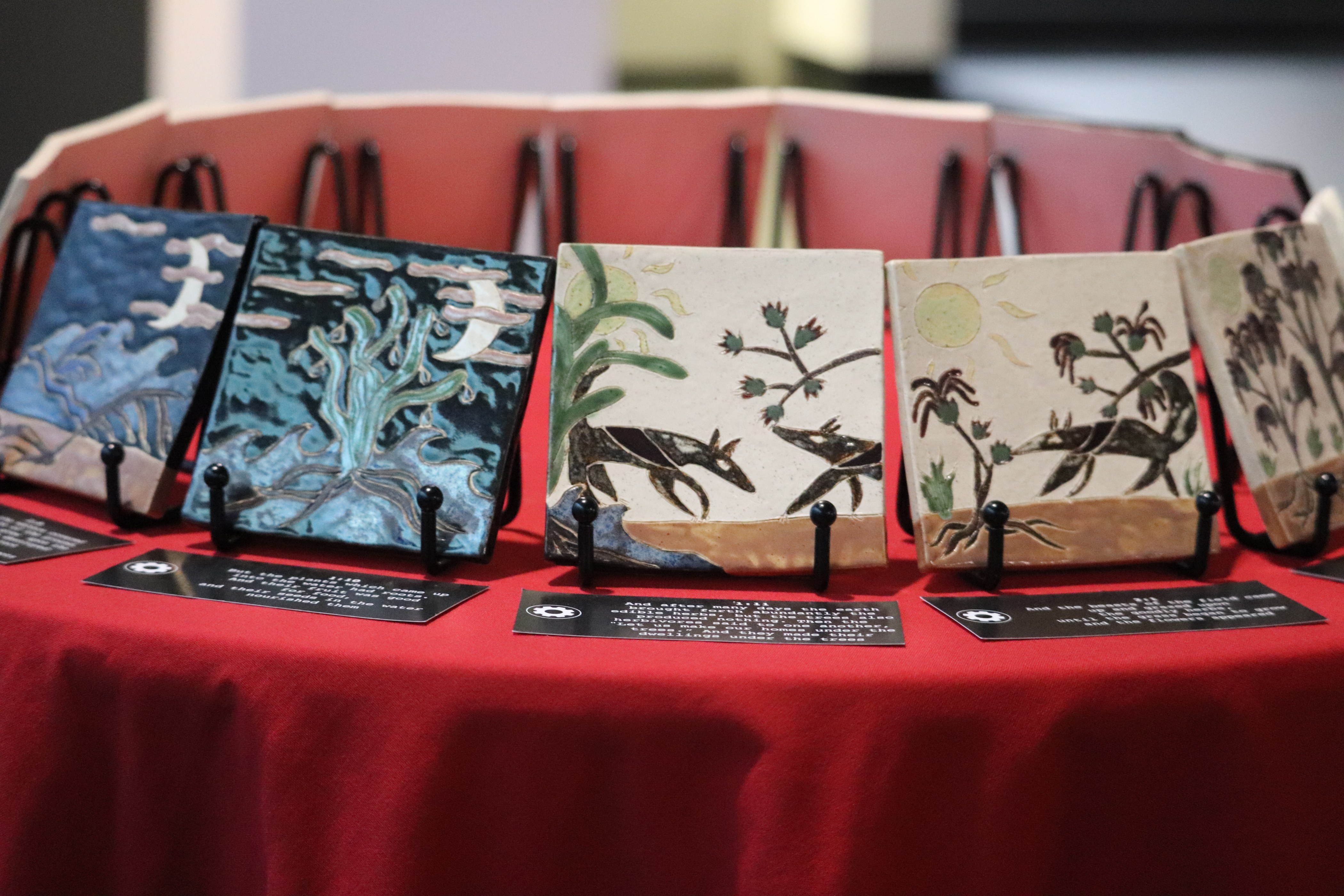
Across the hall, the midday art exhibition in the Zodiac Lobby offered a different way of thinking about AI. Organized by PhD student Yulong Hu, “Beyond: Artistic Expressions in AI” showcased works by Stephanie Dinkins, Esteban Agosin Otero, and Stony Brook’s art students, exploring AI as a system shaped by memory, environment, labor, and culture.
Through video, sound, installation, ceramics, and digital media, these displays examined how artificial systems are trained, what they inherit, where they fail, and how they mediate storytelling, perception, and human-machine relations. It expanded the symposium’s focus beyond research and innovation, reminding attendees that AI is also a cultural force — one that changes how people imagine themselves, each other, and the institutions trying to govern these tools.
The afternoon continued with panels on quantum and AI and neuro-AI, establishing progress in fields that will aid the implementation of artificial intelligence at scale, and with effectiveness. By the time the symposium closed, it had established a community of experts who at once treat AI as infrastructure, method, labor question, scientific lens, economic strategy, and object of cultural interpretation. Experts made room for each other’s strengths and insights, treating their differences as the material of NY’s AI ecosystem.
Lav R. Varshney concluded the event, “AI across New York is not a scattered set of projects anymore. It is turning into a strong network. AI’s future in New York will depend less on one breakthrough than on whether these conversations can continue across campuses, sectors, and disciplines, and whether institutions like SUNY Stony Brook can shape that momentum into a lasting force for artificial intelligence research, innovation, and public good.”
The event was organized and hosted by SUNY Stony Brook University's AI Innovation Institute and the Office for Research and Innovation.