You are cordially invited to attend the biweekly Brookhaven AI Mixer (BAM). BAM includes three short talks on AI research happening at BNL, followed by an open mixer over coffee and snacks for everyone to network and discuss all things AI. The first half hour will consist of presentations that will be available via ZOOM, and the second half hour will be for in person only networking.

Join us every other Tuesday at noon in CDSD's Training Room (building 725, 2nd floor) to learn about interesting AI methods and applications, engage with potential collaborators, prepare for pending FASST funding calls, and build a community of AI for Science at BNL.

Speakers

Kriti Chopra, Computing & Data Sciences (CDS)
Thomas Flynn, Computing & Data Sciences (CDS)
Wenjie Liao, Chemistry Division

Tuesday, January 7, 2025, 12:00 pm -- CDS, Bldg. 725, Training Room

Join ZoomGov Meeting: https://bnl.zoomgov.com/j/1615289117?pwd=Hqkbj9itxWrFnkhZ8rQXHPInO2gxdF.1

Meeting ID: 161 528 9117
Passcode: 991382

The International Neuroethics Society (INS) Speaker Series on AI & Consciousness

AI has existed as a tool for a long time, performing simple tasks such as sorting documents, suggesting music, and so on. But with the development of new generations of AI, the perception of its value to society has been increasing, as it can bring potential and promising benefits in many areas of human life. AI is known to have errors or biases that result in strange or even dangerous responses, but what happens when in AI-human interaction, the latter have errors or biases? cultural errors or biases? And what could be the implications for human relationships?

Speaker Bio

Dr. Karen Herrera-Ferrá is an independent and global consultant on ethical, medical, psychological, legal, social, cultural, policy-making, human rights and political issues and concerns on the development and use of neuroscience, neurotechnology and AI. She is a former member of the Board of Directors of the International Neuroethics Society.

Register here

https://umaryland.zoom.us/meeting/register/tJMvfuqsqDspG9BKMLfUU49UbuUyP_IEvXRh

TITLE: Sampling Using Langevin Diffusions Beyond the Worst-Case by Andrej Risteski of CMU


ABSTRACT: Many tasks involving generative models involve being able to sample from distributions parametrized as p(x) = e^{-f(x)}/Z where Z is the normalizing constant, for some function f whose values and gradients we can query. This mode of access to f is natural -- for instance sampling from posteriors in latent-variable models. Classical results show that a natural random walk, Langevin diffusion, mixes rapidly when f is convex. Unfortunately, even in simple examples, the applications listed above will entail working with functions f that are nonconvex.

We exhibit instances where Langevin diffusion (combined with other tools) can provably be shown to mix rapidly in instances of relevance in practice: distributions p that are multimodal, as well as distributions p that have a natural manifold structure on their level sets. 
Professor Nanpeng Yu from UC Riverside present Machine Learning and Big Data Analytics in Power Distribution Systems.

Abstract: The electric utility industry is being swamped by petabytes of data coming from various sources such as smart meters, phasor measurement units, SCADA systems, geographical information systems and customer management systems. The primary and secondary value embedded in the complex and heterogeneous data sets from power distribution systems is immense. However, algorithms and applications for unlocking the potential of big data in power systems are at an early stage of development. This talk discusses the recent advancement of machine learning algorithms and big data analytics methods in power distribution systems. In particular, we will explain how to develop hybrid algorithms, which synergistically combine the merits of state-of-the-art machine learning algorithms and physical model-based methods. We will take a deep dive into the following applications: network topology identification, electricity theft detection, estimation of behind-the-meter solar generation and data-driven distribution system controls.

Bio: Dr. Nanpeng Yu received his B.S. in Electrical Engineering from Tsinghua University, Beijing, China, in 2006. Dr. Yu received his M.S. degrees in Electrical Engineering and Economics and Ph.D. degree from Iowa State University in 2010. Before joining University of California, Riverside, Dr. Yu was a senior power system planner and project manager at Southern California Edison from Jan, 2011 to July 2014.

Currently, he is an Associate Professor in the Department of Electrical and Computer Engineering at the University of California, Riverside, CA. Dr. Yu is the recipient of the Regents Faculty Fellowship and Regents Faculty Development award from University of California. He received multiple best paper awards from IEEE Power and Energy Society General Meeting, IEEE Power and Energy Society Grand International Conference and Exposition Asia and the Second International Conference on Green Communications, Computing and Technologies.

Dr. Yu is the director of Smart City Innovation Laboratory at UC Riverside. He currently serves as the vice chair of the distribution system operation and planning subcommittee of IEEE Power and Energy Society and the co-chair for IEEE Big Data Applications in Power Distribution Networks Task Force. Dr. Yu currently serves as the associate editor for IEEE Transactions on Smart Grid and International Transactions on Electrical Energy Systems.

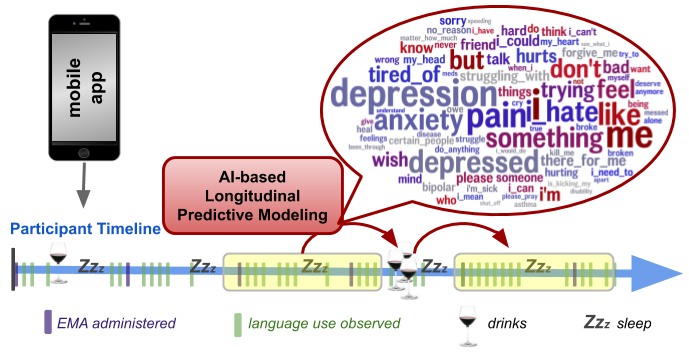
What can you learn from over seven years' worth of Twitter bios? Steven Skiena, Distinguished Teaching Professor of Computer Science and Director of SBU's Institute for AI-Driven Discovery and Innovation, will tell us.

Presenting work done with collaborators Jason Jones, Dakota Handzlik, and Xingzhi Guo, Dr. Skiena will discuss what the team learned about how people portray themselves on social media through their political identities and job status. He'll also show us what you can predict about a person based on their self-description.

If you have a disability and are requesting accommodations in order to fully participate in this event, please email libraryevents@stonybrook.edu or call 631-632-7100.

Register now: https://library.stonybrook.edu/library-events/stem-speaker-series-measuring-self-identity/

Join Klaus Mueller, professor of computer science and interim chair of the Department of Technology and Society, as he hosts Sucheta Lahiri.

Lahiri leads the AI Ethics and Risk Management function at Oxy, where she is responsible for ensuring that the company's AI solutions are developed and deployed in a manner that is ethical, efficient, trustworthy, safe, sustainable, and human-centered. She holds a doctorate from Syracuse University, along with two master's degrees in Applied Statistics and Information Science earned in India.

Zoom: https://stonybrook.zoom.us/j/7851507944?omn=98268154363#success

Fall 2025, Mondays 2 to 3:20 pm, NCS 220 and Zoom link to be announced soon.

The seminar will be jointly taught by Prof. Dimitris Samaras samaras@cs.stonybrook.edu.

The overall purpose of this seminar is to bring together people with interests in Computer Vision theory and techniques and to examine current research issues. This course will be appropriate for people who already took a Computer Vision graduate course or already had research experience in Computer Vision.

To enroll in this course, you must either: (1) be in the Ph.D. program or (2) receive permission from the instructors.

Each seminar will consist of multiple short talks (around 15 minutes) by multiple students. Students can register for 1 credit for CSE656. Registered students must attend and present a minimum of 2 talks. Registered students must attend in person. Up to 3 absences will be excused. Everyone else is welcome to attend.