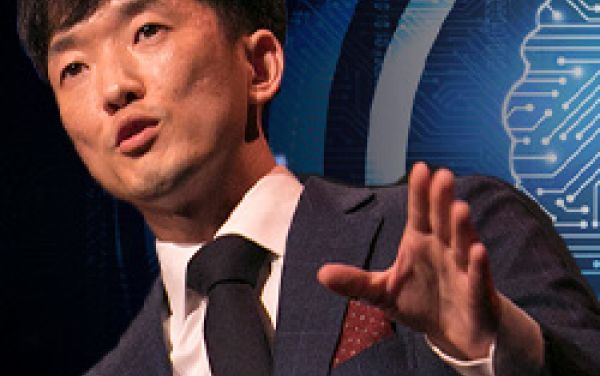
Virtual Talk: Contextual Modeling for Natural Language Understanding, Generation and Grounding by Rui Zhang

Zoom link to come.

Abstract: Natural language is a fundamental form of information and communication. In both human-human and human-computer communication, people reason about the context of text and world state to understand language and produce language response. In this talk, I present 
several deep-neural-network-based systems that first understand the meaning of language grounded in various contexts where the language is used, and then generate effective language responses in different forms for information access and human-computer communication. First, 
I will introduce Speaker Interaction RNNs for addressee and response selection in multi-party conversations based on explicit representations for different discourse participants. Then, I will 
present a text summarization approach for generating email subject lines by optimizing quality scores in a reinforcement learning framework. Finally, I will show an editing-based multi-turn SQL query generation system towards intelligent natural language interfaces to databases. 

Bio: Rui Zhang is a final-year PhD student at Yale University advised by Professor Dragomir Radev. His research interest lies in various natural language processing problems in understanding, generation, and grounding. He has been working on (1) End-to-End Neural Modeling for Entities, Sentences, Documents and Multi-party Multi-turn Dialogues, (2) Text Summarization for Emails, News and Scientific Articles, (3) Cross-lingual Information Retrieval for Low-Resource Languages, (4) Context-Dependent Text-to-SQL Semantic Parsing in Human-Computer Interaction. Rui Zhang has published papers and served as Program Committee members at top-tier NLP and AI conferences including ACL, NAACL, EMNLP, AAAI and CoNLL. During his PhD, he has done research internships at IBM Thomas J. Watson Research Center, Grammarly Research and Google AI. He was a graduate student at the University of Michigan and got his Bachelor's degrees at both the University of Michigan and Shanghai Jiao Tong University from the UM-SJTU Joint Institute.
Virtual Talk: Metadata Matters: Robust Document Classification via Adaptation Methods for Text-driven Public Health by Xiaolei Huang

Zoom link to follow.

Abstract: Document classifiers have been widely applied in solving health-related issues, such as suicide prevention, flu vaccination surveillance and disease diagnosis. However, document metadata including time, gender, age and location has an enormous impact on robustness of 
document classifiers. Language varies across the metadata bringing both challenges and opportunities to build reliable document classifiers. For example, online written language changes over time, and males and females express opinions differently. This talk describes how to use domain adaptation to integrate temporal and user demographic factors into document classifiers. By adapting knowledge of how language varies across the metadata, models can learn generalized representations of language through the metadata-invariant embeddings. 
This approach will lead to metadata-adapted document classifiers and can also extend to personalize classification models by user embedding. 

Bio: Xiaolei Huang is a 4th-year PhD candidate in Information Science at the University of Colorado, Boulder. He is currently a visiting scholar at the Johns Hopkins University. His research interests are in Natural Language Processing, Machine Learning and Public Health. Particularly, he focuses on domain adaptation, cross-lingual transfer learning, user modeling and fairness.
Unlock the power of AI in your job search! Join the Head of Indeed Job Search Academy and AI experts as they explore how to leverage cutting-edge AI tools to optimize your job search activities, enhance your resume, prepare for interviews, and conduct thorough
career research, as well as answer all your AI-related questions.
This virtual watch party session will equip you with the knowledge to stand out in today's competitive market.

https://forms.gle/TtWu3iDh9bmU3niD6

OVERVIEW


This workshop, Expanding Horizons in AI with HPC, aims to explore the dynamic intersection of AI and HPC, focusing on how advanced computing can accelerate AI research and applications. As AI models become more complex and data-intensive, traditional computing systems struggle to meet the demand for scalability, efficiency, and speed. HPC offers a solution by providing the necessary infrastructure for training large-scale models, enhancing AI algorithms, and enabling breakthroughs in fields such as deep learning, natural language processing, and autonomous systems.

Through a combination of expert presentations and panel discussions, participants will gain insights into the latest developments in AI-HPC integration. Attendees will also engage in discussions on the future trends, challenges, and ethical considerations surrounding the use of HPC in AI.

The workshop is designed for AI researchers, data scientists, engineers, and HPC professionals seeking to enhance their understanding of how high-performance computing can drive innovation and expand the potential of AI in solving complex, real-world problems.

The workshop will be held at the Wang Center at Stony Brook University.

https://you.stonybrook.edu/hpcai/

PROGRAM

The program features sessions on HPC Architectures for AI, AI Applications in HPC, LLM's in HPC, and AI in HPC Workflows, and open student presentations. The tentative program and list of confirmed speakers is available at https://you.stonybrook.edu/hpcai/program/.

CALL FOR STUDENT PRESENTATIONS & PARTICIPATION

We are excited to offer students the opportunity to present their work in the area of high-performance scientific computing and artificial intelligence at the workshop. We are calling for students to submit their talk proposals (Name + Title) by April 15 to hpc_ai_workshop@stonybrook.edu. The committee will select the best submission to be presented at the workshop. Accepted speakers will be notified by April 22, 2025.

All students, regardless of whether they are presenting, may reach out to hpc_ai_workshop@stonybrook.edu for financial support to cover travel and lodging costs.

REGISTRATION

Registration is available at https://www.eventbrite.com/e/expanding-horizons-in-ai-with-hpc-tickets-1256469978529?aff=oddtdtcreator until May 2nd. The registration fee covers the workshop participation and the social event in the evening of May 9.

Regular registration: $200
Student registration: $100


IMPORTANT NOTE

The registration fee was meant to cover the room rent, catering, and dinner. Thanks to an RF seed grant, we are able to drop the registration fees for SBU students and staff/faculty. We still ask for an informal registration via email to hpc_ai_workshop@stonybrook.edu until April 27, so we can plan for catering and dinner.
Please get in touch with us if you have already registered as an SBU student/faculty/staff member for the workshop so we can handle any reimbursement.

The program is now online at https://you.stonybrook.edu/hpcai/program/.
CSE 600 Seminar Series | Fall 2025


Abstract: Virtual worlds are prevalent in applications ranging from entertainment, healthcare, retail, to workforce training. With the demand for virtual content growing exponentially, the market for such content is valued at over $200 Billion, which is accelerating the need for advanced computational solutions. In this talk, I will focus on a key challenge in virtual content creation: simulating autonomous agents.
I begin by overviewing this problem domain, through the lens of a physics-based dynamics simulation, which enables the simulation of thousands of agents at interactive rates with GPU programming, achieving a level of performance previously unattainable.
Next, I'll present our recent results in Deep Reinforcement Learning for multi-agent navigation, which enable refined, reward-based strategies to control agent movement. We demonstrate how these techniques can simulate realistic crowds, with broad applications in pedestrians, robots, and swarms. Lastly, I conclude my talk by discussing our lab's work-at-large and the wide range of research opportunities in this emerging area.

Speaker: Tomer Weiss is a professor with New Jersey Institute of Technology since 2020. He received the best student, presentation, and best paper awards in various ACM SIGGRAPH conferences for his work on simulating multi-agent crowds. He was also a finalist in both ACM SIGGRAPH Thesis Fast Forward, and the ACM SIGGRAPH Asia Doctoral Symposium in 2018. He received his PhD in computer science from UCLA in 2018. His research interests include multi-agent dynamics, scene understanding, and interactive visual computing.
The 20th International Conference on Emerging Technologies for a Smarter World (CEWIT 2025)

The Innovation Edge: Harnessing AI for the Future
Exploring Generative AI, Agentic AI, and Frontier Technologies Revolutionizing Healthcare, Defense, Energy, FinTech, and Beyond

Organized by the New York State Center of Excellence in Wireless and Information Technology (CEWIT) at Stony Brook University, our international conference is a destination for researchers, innovators and entrepreneurs, across borders and disciplines. CEWIT2023 conference attracted over 150 industry and academic participants worldwide. Over twenty-three presenters took the podium in breakout sessions and engaging panel discussions.

Continuing the tradition since the inception of our conference in 2003, CEWIT2025 will be a premier forum for presentations of cutting-edge research as well as the exchange and transfer of emerging technologies and innovative applications. We are expecting renowned speakers, presenters and panelists from industry, academia and government, beginning with a series of plenary presentations & a keynote, and followed by several conversational panels - all for an audience ready to network!


Location: The Center of Excellence in Wireless and Information Technology (CEWIT), Stony Brook University

Event Details: Visit CEWIT2025 site to learn more about the event

Questions/Concerns: CEWIT Conference Team at 631-216-7114 or info@cewit.org

Discover how U.S. Census Bureau Tools can help you find free data for your research projects, community, and more. See how to access the latest American Community Survey and 2020 Census data for various geographies including New York City and Long Island at data.census.gov. Learn about Community Resilience Estimates and how to navigate My Community Explorer; an interactive map-based tool which highlights demographic and socioeconomic data that measure inequality. This session will involve live demonstrations and hands-on exercises for participants. Registrants will receive the Zoom link one day prior to the event.

Please Register for SBU Libraries' AI Club: Exploring Census Data here.

The Association for Computational Linguistics is the international scientific and professional society for people working on problems involving natural language and computation. Membership includes the ACL quarterly journals, Computational Linguistics and Transactions of the ACL, reduced registration at most ACL-sponsored conferences, discounts on ACL-sponsored publications, and participation in ACL Special Interest Groups.

An annual meeting is held each summer in locations where significant computational linguistics research is carried out.

For more information and registration, visit the official website.

This symposium will highlight how artificial intelligence (AI) can assist in dementia detection, research and clinical care. For example, the use of robotics to assist with dementia care therapy is truly inspirational and cutting-edge for clinicians, trainees and the community at large, including assisted living facilities. The symposium will also focus on the role of AI in early detection of dementia and in identifying characteristics associated with future cognitive decline.

Learn more and register at https://cme.stonybrookmedicine.edu/continuing-medical-education/conferences/233/alzheimers-symposium-ai-the-future-of-dementia-care-2024/11/15/2024

Abstract:

In recent years, the landscape of artificial intelligence (AI) has been reshaped by the rapid emergence of Foundation Models (FMs). These versatile models have garnered widespread attention for their remarkable ability to transcend the boundaries of traditional, bespoke AI solutions and to generalize to a large set of downstream tasks. In this presentation we will describe the development of geospatial FMs with earth observation and weather data and discuss initial results of such models. We will also show how such foundation models can be a new and exciting tool for assisting with and accelerating scientific discovery.

Speaker:

Hendrik Hamann
Distinguished Researcher
IBM T.J. Watson Research Center