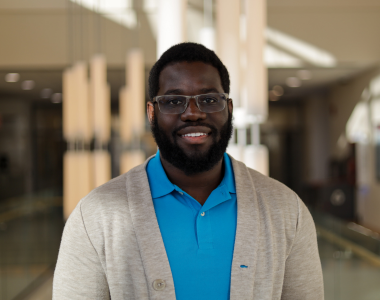
CG Group member (and SBU faculty) Chao Chen will speak on Fri, March 12, about the use of topological data analysis in machine learning for image analysis.
Chao has shared some of his research with the CG Group previously, and this will be a great opportunity to learn more about this exciting research area related to computational geometry/topology!

Time: Friday, March 12, 2pm-3pm
Place: Zoom
https://stonybrook.zoom.us/my/profweizhu?pwd=RjVIVXg3YUhudzZZQ3pheHUydTJBUT09


Title: Learning with Topological Information - Image Analysis and Label Noise
Speaker: Prof. Chao Chen (SBU)

Abstract: Modern machine learning faces new challenges. We are
analyzing highly complex data with unknown noise. Topology provides
novel structural information to model such data and noise. In this
talk, we discuss two directions in which we are using topological
information in the learning context. In image analysis, we propose a
topological loss to segment and to generate images with not only
per-pixel accuracy, but also topological accuracy. This is necessary
in analysis of images of fine-scale biomedical structures such as
neurons, vessels, etc.  Extracting these structures with correct
topology is essential for the success of downstream
analysis. Meanwhile, we discuss how to use topological information to
train classifiers robust to label noise. This is important in practice
especially when we are using deep neural networks which tend to
overfit noise. These results have been published in NeurIPS, ECCV,
ICML and ICLR.
Abstract: AI has achieved remarkable advancements in image recognition and natural language processing. However, its applications in Earth and environmental sciences are still emerging. Unprecedented data from satellites, sensors, and in-situ measurements oIers new opportunities to improve physics-based models and forecasts of environmental systems with AI and to gain deeper insights into these phenomena. Extreme systems, such as weather and climate events, pose distinct challenges for AI, such as limited sampling of rare events, non-trivial data augmentation, errors-in-variables, and complexities of transfer learning across diverse tasks. In this talk, we will explore some of these challenges and showcase AI architectures designed to address them. We will use specific examples of forecasting dust storms, precipitation extremes, flash floods, and drought events in the Middle East. Finally, we will discuss a different AI approach for studying sinkhole formation in the Dead Sea.

Speaker: Prof. Yinon Rudich, Department of Earth and Planetary Sciences, Weizmann Institute, Israel


Join Zoom Meeting
ID: 98731258879
Passcode: cJjGQJqP

Description:

Curious about what AI image generation tools are out there and how they work? Come down to the library Galleria space (outside the Central Reading Room) to see some demonstrations and learn more about them.

Librarians Chris Kretz and Ahmad Pratama, along with David Ecker of DoIT, will be hosting Explore AI demos from Monday - Wednesday this week on different topics. Whether you're new to AI or an experienced user, stop by and take a look!

Location: Library Galleria

TITLE: Sampling Using Langevin Diffusions Beyond the Worst-Case by Andrej Risteski of CMU


ABSTRACT: Many tasks involving generative models involve being able to sample from distributions parametrized as p(x) = e^{-f(x)}/Z where Z is the normalizing constant, for some function f whose values and gradients we can query. This mode of access to f is natural -- for instance sampling from posteriors in latent-variable models. Classical results show that a natural random walk, Langevin diffusion, mixes rapidly when f is convex. Unfortunately, even in simple examples, the applications listed above will entail working with functions f that are nonconvex.

We exhibit instances where Langevin diffusion (combined with other tools) can provably be shown to mix rapidly in instances of relevance in practice: distributions p that are multimodal, as well as distributions p that have a natural manifold structure on their level sets. 
Abstract Driving intelligence test is critical to the development and deployment of autonomous vehicles. The prevailing approach tests autonomous vehicles in life- like simulations of the naturalistic driving environment. However, due to the high dimensionality of the environment and the rareness of safety-critical events, hundreds of millions of miles would be required to demonstrate the safety performance of autonomous vehicles, which is severely inefficient. We discover that sparse but adversarial adjustments to the naturalistic driving environment, resulting in the naturalistic and adversarial driving environment, can significantly reduce the required test miles without loss of evaluation unbiasedness. By training the background vehicles to learn when to execute what adversarial maneuver, the proposed environment becomes an intelligent environment for driving intelligence testing. We demonstrate the effectiveness of the proposed environment in a highway-driving simulation. Comparing with the naturalistic driving environment, the proposed environment can accelerate the evaluation process by multiple orders of magnitude. ZOOM LINK: Meeting ID: 950 6760 3617; Passcode: 426506 https://stonybrook.zoom.us/j/95067603617?pwd=dXQybEprSkNlTFY3WHlWYjViUG95UT09 Bio Professor Henry Liu is a professor in the Department of Civil and Environmental Engineering at the University of Michigan, Ann Arbor. He is also a Research Professor at the University of Michigan Transportation Research Institute and the Director for the Center for Connected and Automated Transportation (USDOT Region 5 University Transportation Center). Prof. Liu conducts interdisciplinary research at the interface between civil and mechanical engineering. Specifically, his scholarly interests concern traffic flow monitoring, modeling, and control, as well as testing and evaluation of connected and automated vehicles. He has published more than 100 refereed journal papers and is listed as one of the top 50 leading authors in the past 50 years (1969-2019) in the prestigious Transportation Research journal. Professor Liu and his work have been widely recognized in public media for promoting smart transportation innovations. He has appeared on media outlets including CNBC, Forbes, Technode, etc. In 2019, Professor Liu was invited to testify on national transportation research agenda in front of the US House Subcommittee on Research and Technology. Professor Liu has nurtured a new generation of scholars, and some of his PhD students and postdocs have joined first class universities such as Columbia University, Purdue University, RPI, etc. Prof. Liu is the managing editor of Journal of Intelligent Transportation Systems.
The overall purpose of this seminar is to bring together people with interests in Computer Vision theory and techniques and to examine current research issues. This course will be appropriate for people who already took a Computer Vision graduate course or already had research experience in Computer Vision. To enroll in this course, you must either: (1) be in the Ph.D. program or (2) receive permission from the instructors. Each seminar will consist of multiple short talks (around 15 minutes) by multiple students. Students can register for 1 credit for CSE656. Registered students must attend and present a minimum of 2 talks. Registered students must attend in person. Up to 3 absences will be excused. Everyone else is welcome to attend. The seminar will be taught by Prof. Chao Chen, chao.chen.1@stonybrook.edu.
The overall purpose of this seminar is to bring together people with interests in Computer Vision theory and techniques and to examine current research issues. This course will be appropriate for people who already took a Computer Vision graduate course or already had research experience in Computer Vision. To enroll in this course, you must either: (1) be in the PhD program or (2) receive permission from the instructors. Each seminar will consist of multiple short talks (around 15 minutes) by multiple students. Students can register for 1 credit for CSE656. Registered students must attend and present a minimum of 2 talks. Everyone else is welcome to attend. Fill in https://forms.gle/q6UG9ygauLp2a8Po8 to subscribe to our mailing list for further announcement.
DeepMath Conference on the Mathematical Theory of Deep Neural Networks Recent advances in deep neural networks (DNNs), combined with open, easily-accessible implementations, have made DNNs a powerful, versatile method used widely in both machine learning and neuroscience. These advances in practical results, however, have far outpaced a formal understanding of these networks and their training. The dearth of rigorous analysis for these techniques limits their usefulness in addressing scientific questions and, more broadly, hinders systematic design of the next generation of networks. Recently, long-past-due theoretical results have begun to emerge from researchers in a number of fields. The purpose of this conference is to give visibility to these results, and those that will follow in their wake, to shed light on the properties of large, adaptive, distributed learning architectures, and to revolutionize our understanding of these systems.​​​