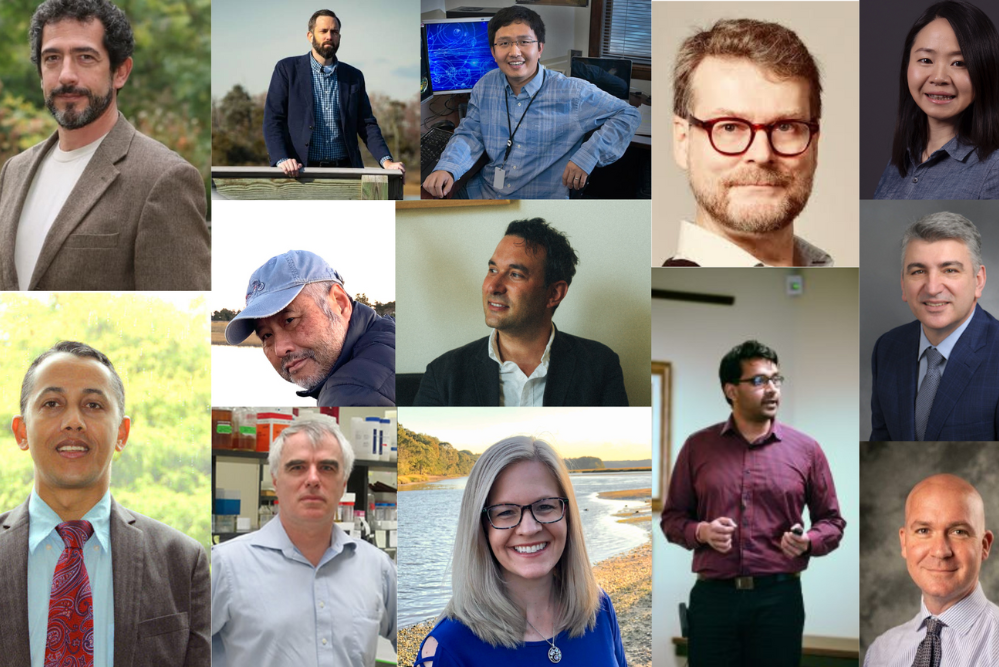
The SUNY Office of Research, Innovation & Economic Development (ORIED) is hosting a webinar, Pathways to Innovation: Exclusive STEM Opportunities for Students at Premier Labs, with the Air Force Research Laboratory (AFRL), the Griffiss Institute and Brookhaven National Laboratory (BNL).

Please join us on October 30 from 12:30 - 2:00 pm to learn more about the labs and the wide variety of research, education, and workforce development programs they offer.

Register here: https://rfsuny.zoom.us/webinar/register/WN_fjWNU9l8Sr6WO_M3AoZ-Rw?mc_cid=50c2045945&mc_eid=357e15f9df#/registration

Abstract: Implicit functions have long been a fundamental representation for both 2D and 3D objects in computer graphics, playing a significant role in the field's early development. With the rise of 3D deep learning and the rapid advancement of neural rendering techniques, implicit representations of 3D shapes have regained significant attention in recent years. In this talk, I will present several recent research projects focusing on implicit function-based 3D reconstruction and neural rendering. Furthermore, I will discuss potential future developments in this dynamic and rapidly evolving field.

Biography: Ying He is an Associate Professor at the College of Computing and Data Science, Nanyang Technological University, where he also serves as the Director of the Centre for Augmented and Virtual Reality. His research interests lie in geometric computation and analysis, with applications spanning computer graphics, 3D vision, computer-aided design, multimedia, and wireless sensor networks. Dr. He is an active member of the technical program committees for major conferences on geometric modeling and has served on the editorial boards of IEEE Transactions on Visualization and Computer Graphics, Computer Graphics Forum, and Computational Visual Media. He has also taken on key leadership roles as General/Program Co-Chair for several conferences, including Shape Modeling International (SMI) 2022, Solid and Physical Modeling (SPM) 2022 & 2023, Geometric Modeling and Processing (GMP) 2014 & 2021, and Computational Visual Media (CVM) 2020. For more information, please visit https://personal.ntu.edu.sg/yhe/

Location: NCS 115

How do you get the most out of generative AI? Stop by the library Galleria outside of the Central Reading Room to learn more! Librarians Chris Kretz and Ahmad Pratama, along with David Ecker of DoIT, will be demonstrating tools and tips for writing prompts that make the most of what AI can do. And they'll be hosting Explore AI demos this Monday - Wednesday (March 3rd-5th) 12:30 - 1:30. Whether you're new to AI or a current user, they'd love to talk to you about it.

Location: Melville Library Galleria
Abstract:

Photorealistic editing of human facial expressions and head articulations remains a long-standing topic in the computer graphics and computer vision community. Methods enabling such control have great potential in AR/VR applications where a 3D immersive experience is valuable, especially when this control extends to novel views of the scene in which the human subject appears. Traditionally, 3D Morphable Face Models (3DMMs) have been used to control the facial expressions and head pose of a human head. However, the PCA-based shape and expression spaces of 3DMMs lack the expressivity. They cannot model essential elements of the human head such as hair, skin details, and accessories such as glasses that are paramount for realistic reanimation. In this thesis, we present a set of methods that enables facial reanimation, starting from editing expressions in still face images to creating fully controllable neural 3D portraits with control over facial expressions, head pose, and viewing direction of the scene using only casually captured monocular videos from a smartphone to finally achieving studio-like quality from the said monocular captures.
First, we propose a method for editing facial expressions in near-frontal facial images through the unsupervised disentangling of expression-induced deformations and texture changes. Next, we extend facial expression editing to human subjects in 3D scenes. We represent the scene and the subject in it using a semantically guided neural field. This enables control over the subject's facial expressions and the viewing direction of the scene they're in. We then present a method that learns, in an unsupervised manner, to deform static 3D neural fields using facial expression and head-pose dependent deformations, enabling control over facial expressions and head pose of the subject along with the viewing direction of the 3D scene they're in. Next, we propose a method that makes the learning of the aforementioned deformation field robust to strong illumination effects, which adversely impact the registration of the deformation. We then propose an extension of this unsupervised deformation model to 3D Gaussian splatting by constraining it using a 3D morphable model, resulting in a rendering speed of 18 FPS--a 100x speed improvement over prior work. Finally, we propose a method that bridges the quality gap between 3D portraits created using in-the-wild monocular data and multi-view studio capture data. We accomplish this using a two-stage method. First, we train a StyleGAN to relight and inpaint in-the-wild face texture maps (with strong illumination effects and incompletely captured regions). Next, we both reconstruct and generate identity-specific facial details that may be poorly captured in the in-the-wild captures. Once trained, we can generate studio-like complete avatars from monocular phone captures.

Speaker: Shahrukh Athar

Zoom Link:
https://stonybrook.zoom.us/j/94228500743?pwd=RqOBgG6tbJkKaFBlWFwBkYFX0VRovV.1

Meeting ID: 94228500743
Passcode: 661599
The Division of Educational & Institutional Effectiveness is excited to host International Love Data Week at SBU, February 9-13, 2026!
Join us for a mix of 30-minute virtual sessions, an in-person kickoff on Monday, and a student-focused event on Wednesday celebrating data and data-informed decision-making.
Wrap up the week at the Love Data Week Open House on Friday, 2/13 with light refreshments, data-themed swag, photos with Wolfie, and time to connect with presenters.
Learn more and register on https://www.stonybrook.edu/commcms/oee/recognition/Love%20Data%20Week%202026%20Save%20the%20Date%20Placeholder.php

Jerome Liang, PhD 

Professor of Radiology, Biomedical Engineering, Electric and Computer Engineering, and Computer Science 

Co-Director of Research 

Department of Radiology 


Artificial intelligence, machine learning and computer-aided diagnosis in cancer Imaging 

February 11, 2021 

12:00pm - 1:00pm 

Virtual Seminar - Zoom 

https://stonybrook.zoom.us/j/98155629970?pwd=YzRvcnJnTlNTT1E5ak1oZEJvWTZHQT09 

Meeting ID: 981 5562 9970 

Passcode: 950410 

Host: 

Wei Zhao, PhD 

Professor of Radiology and Biomedical Engineering 

Educational Objectives  

Upon completion, participants should be able to:  

(1) Learn different medical image representations of cancer attributes, such as heterogeneity, high tendency to grow, etc.  

(2) Learn how computer (machine) can be trained (or programmed) to recognize the image representations.  

(3) Learn how artificial intelligence can drive the machine learning to maximize the performance of computer-aided diagnosis (CADx).  

Disclosure Statement  

In compliance with the ACCME Standards for Commercial Support, everyone who is in a position to control the content of an educational activity provided by the School of Medicine is expected to disclose to the audience any relevant financial relationships with any commercial interest that relates to the content of his/her presentation.  


The speaker, Jerome Liang, PhD, the planners; and the CME provider have no relevant financial relationship with a commercial interest (defined as any entity producing, marketing, re-selling, or distributing health care goods or services consumed by, or used on, patients), that relates to the content that will be discussed in the educational activity.  


CONTINUING MEDICAL EDUCATION CREDITS  

The School of Medicine, State University of New York at Stony Brook, is accredited by the Accreditation Council for Continuing Medical Education to provide continuing medical education for physicians.  


The School of Medicine, State University of New York at Stony Brook designates this live activity for a maximum of 1.0 AMA PRA Category 1 Credits™. Physicians should only claim credit commensurate with the extent of their participation in the activity.  


Should you be logging in Zoom by using your tablet or mobile device, please be sure to add your Full Name and/or Email for CME credit. 

Research challenges in using computer vision in robotics systems Abstract The past decade has seen a remarkable increase in the level of performance of computer vision techniques, including with the introduction of effective deep learning techniques. Much of this progress is in the form of rapidly increasing performance on standard, curated datasets. However, translating these results into operational vision systems for robotics applications remains a formidable challenge. This talk with explore some of the fundamental questions at the boundary between computer vision and robotics that need to be addressed. This includes introspection/self-awareness of performance, anytime algorithms for computer vision, multi-hypothesis generation, rapid learning and adaptation. The discussion will be illustrated by examples from autonomous air and ground robots.

AI on Campus: Your Thoughts, Your Future

Join the Conversation: Share Your Thoughts about Learning, Academics, and AI

The world of college is changing fast, and Artificial Intelligence (AI) is at the center of it. We are part of the Institute on AI, Pedagogy, and the Curriculum with AAC&U, and we need to hear from the people AI affects most: you!

This is an open discussion for all students to share their honest experiences, their top concerns, and their best ideas about AI in our academic environment. We'll be diving into these key questions:

  • How can AI actually make learning better or easier? What opportunities do you see for using AI tools to enhance your assignments, research, or skills?

  • What are your biggest worries about AI? Is it about cheating, being graded fairly, or preparing for the job market? How is AI impacting your workload or stress levels?

  • What specific tools, workshops, or policies would help you use AI responsibly and successfully? (Think training, software, or clear rules.)

Dates/Times:

  • Wednesday, 2/4 at 2pm

  • Thursday, 2/5 at 12pm

Please register in advance for the Zoom link.

Can't Make It? Share Your Feedback!

Don't worry if you can't attend! You can still share your thoughts via video in our AI Zoom Room or via email: rose.tirotta-esposito@stonybrook.edu.

Videos will not be shared publicly and comments will only be shared in aggregate.

Your voice matters. Come tell us how AI is affecting your studies, your stress, and your success!

  • Dr. Rose Tirotta-Esposito (Assistant Provost; Director of CELT)

  • Dr. Elizabeth Hewitt (Associate Professor in the Department of Technology and Society (DTS) in the College of Engineering and Applied Sciences)

  • Chris Kretz (Associate Librarian and Head of Academic Engagement at SBU Libraries)

  • Prof. Rajiv Lajmi (Assistant Professor in the School of Health Professions and Chair of Applied Health Informatics)

  • Dr. Matthew Salzano (Assistant Professor in the Department of Communication in the School of Communication and Journalism)