Abstract:
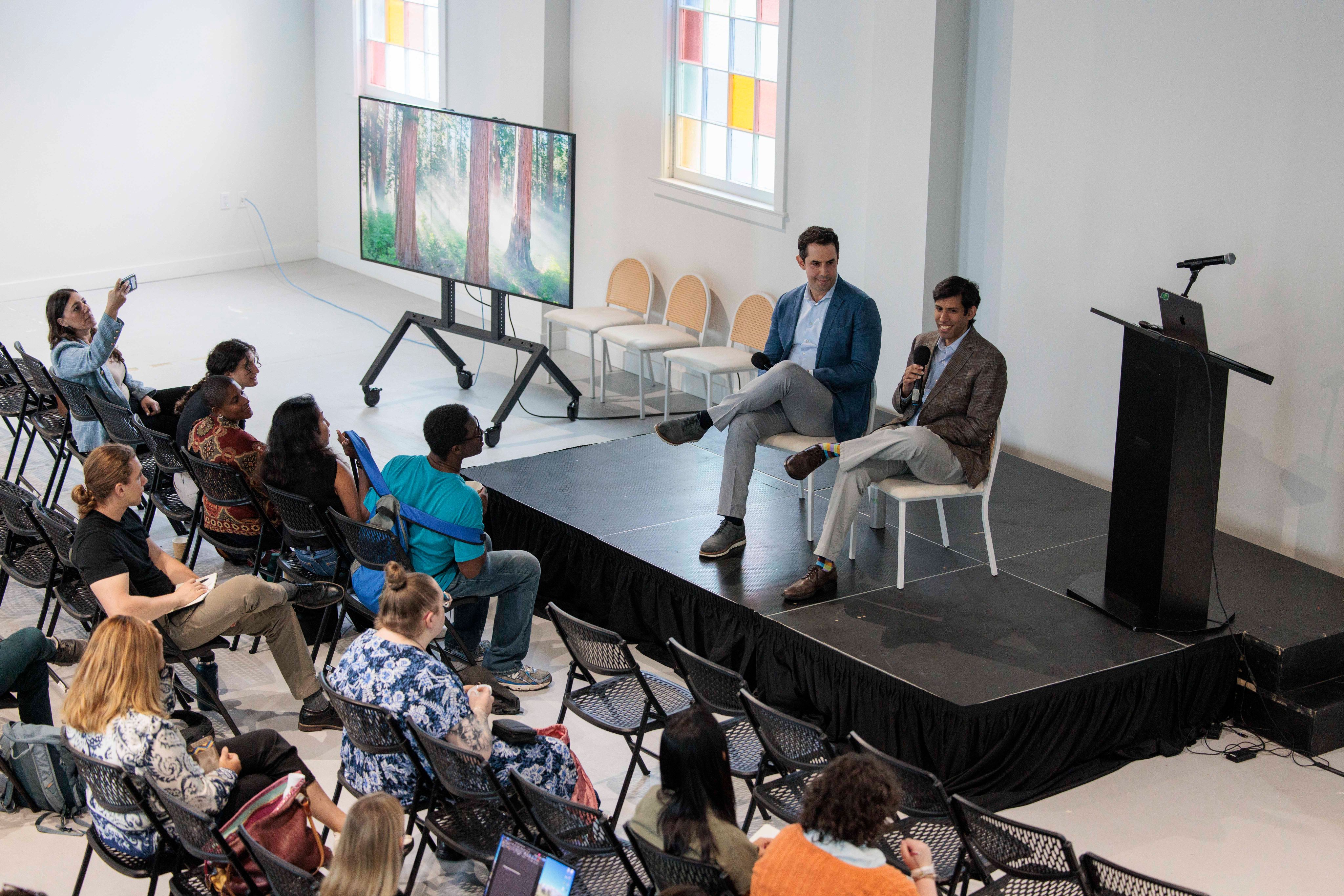
Quantifying similarity is a central notion in science and data analysis, pervading everything from phylogenetic trees to the foundation of clustering. Unfortunately, despite being examined and applied for decades, traditional similarity and distance metrics have fundamental drawbacks. The key problem is that all of them are only defined over pairs of objects, so they scale quadratically when one tries to compare N objects. The present explosion in the amount of data available to us requires new ways to process information, and while some current algorithms can handle millions of points, we need alternatives applicable to billions. This is what motivated us to develop a new framework that can compare any number of objects at the same time. With this, we achieve an unprecedented linear scaling when comparing multiple objects. Here we will discuss the main properties of this formalism, along with its applications in drug design and to the analysis of Molecular Dynamics (MD) simulations. Our indices have proven to be incredibly versatile when applied to chemical space exploration and visualization, allowing us to rigorously quantify the chemical diversity of very large molecular libraries. This has led to the creation of several algorithms to sample important regions in chemical space, including a more efficient way of identifying the prevalence of activity cliffs. Additionally, our indices provide a convenient route to sample complex MD trajectories, allowing to identify representative structures very efficiently. Moreover, we can also cluster biological ensembles in a more robust way than with standard algorithms, which has led to our group's work on MDANCE, a very flexible and efficient open-source clustering module. Drop by if you want to know how we clustered one billion molecules!
Speaker:
Assistant Professor, Department of Chemistry and Quantum Theory Project
University of Florida, Gainesville
Website: https://quintana.chem.ufl.edu/
Location:
Laufer Center Lecture Hall 101
Abstract: The development of embodied AI has largely focused on scaling data and computational power, often at the cost of energy efficiency. In contrast, biological intelligence achieves remarkable adaptability with minimal resources, inspiring a shift toward neuromorphic AI, an approach that mimics the structure and dynamics of biological neural systems. In this talk, I will explore the promises and challenges of neuromorphic computer vision from three key perspectives: algorithms, robot actions, and data. First, I will discuss algorithmic advances, including continuous visual hull reconstruction, continuous-time human motion field estimation, and unsupervised independent motion segmentation. Next, I will illustrate how neuromorphic vision enables agile robotic actions by leveraging event-based perception for real-time decision-making. Finally, I will address challenges in training data-driven models with event data, highlighting strategies to enhance data availability and efficiency. By integrating these elements, neuromorphic AI paves the way for energy-efficient, high-performance embodied intelligence in dynamic real-world environments.
Speaker Bio: Ziyun (Claude) Wang is a fifth-year Ph.D. student in the General Robotics, Automation, Sensing & Perception (GRASP) Lab at the University of Pennsylvania, advised by Professor Kostas Daniilidis. His research focuses on developing algorithms for neuromorphic computer vision and integrating them with real hardware to enable agile perception in embodied AI systems. Prior to his Ph.D., he worked at the Samsung AI Center New York, where he developed 3D reconstruction techniques for robotic applications and earned three patents. He also contributed to the Apple Vision Pro team, enhancing user comfort for AR glasses. His research work has been recognized at major computer vision, robotics, and machine learning venues including the AAAI Conference on Artificial Intelligence (AAAI), European Conference on Computer Vision (ECCV), International Conference on Learning Representations (ICLR), Conference on Computer Vision and Pattern Recognition (CVPR) workshops, and IEEE Robotics and Automation Letters (R-AL), with an oral presentation at ECCV placing in the top 2.7%. His research aims to drive the development of next-generation bio-inspired AI systems, enabling more efficient, adaptive, and intelligent embodied perception.The overall purpose of this seminar is to bring together people with interests in Computer Vision theory and techniques and to examine current research issues. This course will be appropriate for people who already took a Computer Vision graduate course or already had research experience in Computer Vision. To enroll in this course, you must either: (1) be in the PhD program or (2) receive permission from the instructors.
Each seminar will consist of multiple short talks (around 10 minutes) by multiple people. Students can register for 1 credit for CSE656. Registered students must attend and present a minimum of 2 or 3 talks. Everyone else is welcome to attend. Fill in https://forms.gle/pCVXovgfMfQwGqG38 to subscribe to our mailing list for further announcement.
First, the dissertation focuses on uncovering cognitive styles or thinking patterns manifesting in language. We demonstrate that modeling language at deeper semantic levels such as discourse relations, can unveil latent psychological states and traits, including cognitive styles that influence both mental health and behavior. Introducing a novel blend of transfer and active learning, we efficiently curated a new set of linguistic data on cognitive styles like dissonance. This approach allows for more precise measurement when dealing with rare-classes and low-resource tasks. As a second contribution, effective validation methods are introduced to language-based assessments of the underlying cognitive styles. Controlled behavioral experiments and online studies show that cognitive styles detected through linguistic signals reliably predict real-world behaviors such as decision-making and engagement with extremist communities, both at the individual and community levels, sometimes months in advance
The research further moves beyond traditional measurement tools like questionnaires and expert judgments, which rely on Classical Test Theory, by establishing that language-based assessments more closely approximate true psychological states. The mechanisms by which these assessments outperform standard tools are explained, highlighting their predictive power for behaviors linked to underlying traits. Finally, a more sophisticated approach is explored by modeling psychological outcomes with Item Response Theory (IRT), an improvement over Classical Test Theory. Adaptive language-based assessments are introduced, showing that targeted, adaptive testing based on latent IRT scores can efficiently and accurately capture multiple psychological dimensions.
Taken together, these contributions argue for a shift towards language-based psychological assessments. By integrating deeper discourse-level semantics with measurement theory, this dissertation charts a path towards truer scores of mental states: ones that are more precise, and reflective of the complexity of human cognition and emotions.
Speaker: Vasudha Varadarajan
https://stonybrook.zoom.us/j/
Abstract: In this talk, I will highlight three key aspects of large language models: (1) cultural bias in LLMs and pre-training data, (2) decoding algorithm for low-resource languages, and (3) human-centered design for real-world applications.
The first part focuses on systematically assessing LLMs' favoritism towards Western culture. We take an entity-centric approach to measure the cultural biases among LLMs (e.g., GPT-4, Aya, and mT5) through natural prompts, story generation, sentiment analysis, and named entity tasks. One interesting finding is that a potential cause of cultural biases in LLMs is the extensive use and upsampling of Wikipedia data during the pre-training of almost all LLMs. The second part will introduce a constrained decoding algorithm that can facilitate the generation of high-quality synthetic training data for fine-grained prediction tasks (e.g., named entity recognition, event extraction). This approach outperforms GPT-4 on many non-English languages, particularly low-resource African languages. Lastly, I will showcase an LLM-powered privacy preservation tool designed to safeguard users against the disclosure of personal information. I will share findings from an HCI user study that involves real Reddit users utilizing our tool, which in turn informs our ongoing efforts to improve the design of AI models.
Bio:
Wei Xu is an Associate Professor in the College of Computing and Machine Learning Center at the Georgia Institute of Technology, where she is the director of the NLP X Lab. Her research interests are in natural language processing and machine learning, with a focus on Generative AI, robustness and fairness of large language models, multilingual LLMs, as well as AI for science, education, accessibility, and privacy research. She is a recipient of the NSF CAREER Award, Google Academic Research Award, CrowdFlower AI for Everyone Award, Best Paper Awards and Honorable Mentions at COLING'18, ACL'23, ACL'24. She also received research funds from DARPA and IARPA. She is currently an executive board member of NAACL. Join Zoom Meeting https://stonybrook.zoom.us/j/98855994362?pwd=F2qnpwL85fhCBHAEW9ZBpXihfwGHsj.1 (ID: 98855994362, passcode: 172797) Join by phone (US) +1 646-876-9923 (passcode: 172797) Joining instructions: https://www.google.com/url?q=https://applications.zoom.us/addon/invitation/detail?meetingUuid%3DuDJcUTvyQueZkCaUSAwFlg%253D%253D%26signature%3Da3d49e0f7f2e74e7130f7308c74bd85ba7b99587b98ba2e34238bb657ca51a09%26v%3D1&sa=D&source=calendar&usg=AOvVaw2jTn5cjfRG8vXU8KHHlU2Y Meeting host: H.Andrew.Schwartz@stonybrook.edu
Join Zoom Meeting:
https://stonybrook.zoom.us/j/98855994362?pwd=F2qnpwL85fhCBHAEW9ZBpXihfwGHsj.1
What new tools and extra powers are available to you through the library's subscription databases? Join faculty librarian Chris Kretz, Head of Academic Engagement, on a tour of what's available and how you might best use them.
International Love Data Week is a global event dedicated to celebrating data in all its forms. This year, Stony Brook University is excited to celebrate Love Data Week with a series of 30-minute webinars aimed to promote proficiency with data, showcase innovative data projects, and foster a community of data enthusiasts across campus. Hosted by the Division of Educational & Institutional Effectiveness and facilitated by the Office of Educational Effectiveness, we invite all SBU faculty, staff and students to join in the festivities, learn from colleagues in our campus community, and fall in love with the power of data! Learn more here. |
The AI Community will be hosting our very first Datathon๐ก๐
Ready to turn data into groundbreaking insights? ๐ง
Compete in our Datathon, where you'll analyze real-world data ๐ and share innovate solutions in these tracks:
๐ซ Student Life
๐ฑ Environment & Sustainability
๐ Health & Wellness
๐ฐ Finance & Economics
Whether you're a data pro or just starting out, this is your chance to network, learn, and win exciting prizes! ๐๐ Bring your creativity ๐งฉ collaborate with fellow students ๐งโ๐คโ๐ง and gain hands-on experience showcasing your analytical skills ๐ป
Submissions will be judged by professors ๐งโ๐ซ so take this chance to impress them!
There will be free food โ and games ๐ฒ to fuel your brain and imagination! Don't miss out--register now and unleash the power of data! ๐ฅโจ
Registration Form: https://forms.gle/
Time: Friday (4/4) 10:30am - 5pm โฐ
Location: Bauman Center ๐
at International Love Data Week
sponsored by The Office of the Provost and
Educational and Institutional Effectiveness (EIE)
Special Talk and Panel Discussion
How I Learned to Stop Worrying and Love AI (For Now)
with Paul Fain from The Job and Work Shift
A reporter's take on what we know--and what we don't know--about AI's emerging impacts on the labor market. The discussion will include the latest research from economists and the AI labs themselves about how workers are using AI, and current thinking among experts on how the tech's rapid deployment will play out across job roles, industries, and regions.
Panel discussion to follow with:
- Lav Varshney, Della Pietra Infinity Professor and inaugural director of the AI Innovation Institute
- Nicholas Johnson, Director of AI, SBU Libraries
- Marianna Savoca, Associate Vice President for Career Readiness and Experiential Education
Limited Seats!
Registration is required.
Shadows provide useful cues to analyze the scene but also hamper many computer vision algorithms such as image segmentation, object detection or tracking. For those reasons, shadow detection and shadow removal have been well studied topics in computer vision. Early approaches for shadow detection and removal focus on physical illumination models of shadows. These methods can express, identify, and remove shadows in a physically plausible manner. However, these models are often hard to optimize and slow in inference due to reliance on hand-designed image features. On the other hand, recent deep-learning approaches have achieved breakthroughs in performances for both shadow detection and removal. They learn to extract useful features automatically through training while being extremely efficient in computation. However, these models are data-dependent, opaque and ignore the physical aspects of shadows.
We propose to incorporate physical illumination constraints into deep-learning frameworks. Thus the mapping learned by the deep-network closely follows the physics of shadows, enabling the network to systematically and realistically modify shadows in images. For shadow detection, we present a novel GAN framework in which the generator can generate realistic images with attenuated shadows that can be used to train a shadow detector. For shadow removal, we propose a method that uses deep-networks to estimate the unknown parameters for a shadow image formation model that removes shadows. The system outputs shadow-free images in high-quality with no image artifacts and achieves state-of-the-art shadow removal performance. Lastly, we propose a system trained without the need for any shadow-free images in which physical constraints play pivotal roles that enable training the networks.
For Zoom information, please email events@cs.stonybrook.edu.